 When five nations pledged to support the development of a new national forum on small business development in Tokyo in 1975, they included Japan, the US, Canada, South Korea and Taiwan. We had the backing of two powerful agencies, the Small Business Administration in Washington and MITI in Japan.
And with their support suddenly we also had the attention of the world’s aid agencies like the World Bank. It was all part of our vision to combine small scale development with initiatives to reduce poverty and social instability.
Most people, I believe, assume that if your interest is in reducing poverty you lean left in your politics and if your interest is in encouraging enterprise your politics is of the right.
But as I got to know the senior spokespeople for groups like the World Bank, I found them more pragmatic than ideological. They had multiple programs for providing funding to less developed nations, but they wanted to learn from attending our conferences just how you convert government funding into small scale development initiatives.
Here’s the kind of talk I listened to at some of the sessions I attended. Provide money for infrastructure like roads and electric power. That is a standard World Bank to national government initiative.
But have other agencies, that reach down to the street level, provide mini-financing so people can buy bicycles to get their goods to market or pumps to provide fresh drinking water. And fertilizer to help farmers become more productive.
It was interesting how in the early days the big numbers on poverty in terms of average income per day were from China and India. But by the year 2000 these same nations were the big success stories
It is a story about nations that average say 8% growth for twenty years. Growth that always spills out into communities. Well that is the conventional strategy for national growth. China and India became major trading nations. That is what their success was all about.
It was always interesting over the years how the membership of the Canadian Federation of Independent Business always supported trade agreements by a ratio of about 3:1.
Whether they were directly impacted or not, business people know trade stimulates economic growth. And it is the same phenomenon with small business groups everywhere.
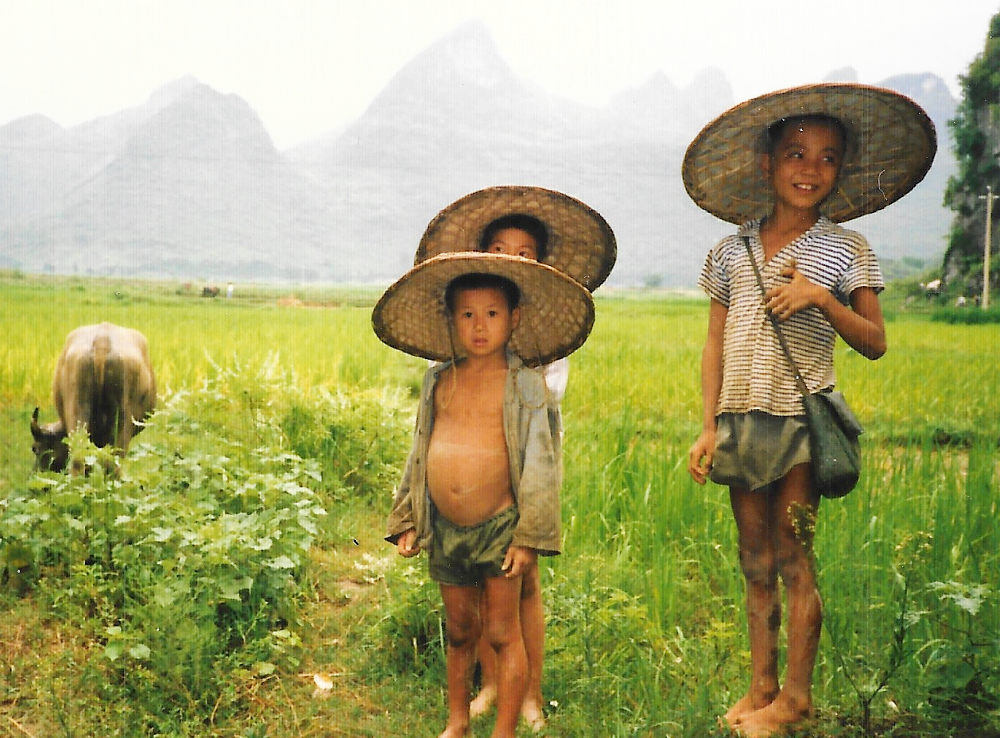
During our trip to China on our 30th wedding anniversary in 1985, it was easy to observe that the urban centres on the east coast of China, like Beijing and Shanghai were simply booming. And yet when we visited the rural areas in central China we could see real evidences of poverty. It is a similar story in India. Rapid growth is never evenly distributed.
The photograph was taken on a bus tour in the Chinese country-side and the image of children working on their parent’s farm is very tender and memorable. The real challenge was educating farmer’s children, so they could move to the city and get better jobs.
It was interesting over the years trying to determine if the more authoritarian system of China or the more democratic system of India would be more successful in dealing with poverty. My conclusion was that both systems worked because they delivered.
Both countries mixed free enterprise in the urban areas with socialism in the rural areas to encourage growth and the reduce poverty. It was a mix of enterprise creation and income transfers.
When I was first married and living in a very modest little home, a Swiss carpenter and ex-farmer moved in next door. And he immediately took out the grass in his back yard and started to plant his own vegetable garden and raspberry patch. Then he built cages to breed and grow rabbits.
We were invited over to his home after he was settled in for a year and had a feast based on everything grown in the garden. He told the kids they were eating chicken and not “Fluffy”. He said he traded rabbits for beef with a local butcher.
I couldn’t help thinking that if the knowledge my neighbour possessed could be made available to millions of poor around the world they could become self sufficient in food.
And later in life, trying to appreciate what the international aid agencies were doing, I learned that a fundamental part of their work was agricultural training.
It is one thing to subsidize food which lots of nations do, but another thing to teach people how to grow their own.
It can become very baffling and discouraging attending conferences and listening to experts discuss all the various initiatives being undertaken in this country and that country to eradicate poverty and stimulate development. There are just no standard formulae.
I could never get my head around numbers like a billion people that do not earn say a $1.90 US a day. Extreme poverty was like $1.25 a day. As someone who never knew hunger it was hard to make these numbers feel real. During a visit in the 1977 to Manila in the Philippines I was propositioned by a young girl who said she was 14 years of age. She said her father was fighting in the hills and if he came home he would be arrested. It became her job to support her mother and two younger siblings.
It was because of this experience that I saw the real nature of poverty and what it does to families.
From a pure practical economic perspective, business and political leaders everywhere should be interested in turning the poor into consumers and producers.
But to those who have been poor or for someone like myself thinking of that young girl in Manila, it was personal.
That’s the way I see it anyways.
12-03 Successes
(blank) » John Bulloch » 25 Quirky Opinions » 12 Poverty »
Aid agencies focus on big stuff like roads and electric power. Governments focus on small stuff like financing small business.