 It was three weeks during the summer of 1954 that my brother and I toured Europe, and I remember coming home with a cloth bag full of loose change from all the nations we had visited.
No credit cards then, just US dollar American Express traveller’s cheques and pockets full of different currencies that we tried to convert back to US dollars at the end of our tour. Now is there anything more globalizing than credit cards?
I distinctly remember the bombed-out cities of West Germany and seeing construction cranes everywhere. Germany was coming back as a major economy.
It is a great moment in history when, four years later, Chancellor Konrad Adenauer signed the Treaty of Rome to create the European Economic Commission with six original members: West Germany, France, Luxemburg, Belgium, The Netherlands and Italy. Today it is referred to as the European Union or EU.
And Germany, even then, was what economists call a “hegemon” or dominant rising power. And the EU referred to as the German empire.
Whenever I dropped a fancy word like “hegemon” my grandfather would complain that I had too much “edumacation”.
Closely following the development of the European Community over the years strengthened my view that the world is made up of regional blocks but that within these economic and political centres of power giant corporations find ways to function.
For example, large numbers of Canadian and US firms established facilities in Southern Ireland, with its use of the English language, their use of the Euro and access to a EU market of 510 million people.
What is so different about the EU is the extent to which it is integrating its 28 members in terms of immigration, labour policy, finance and trade. And 19 of these nations are all using the Euro.
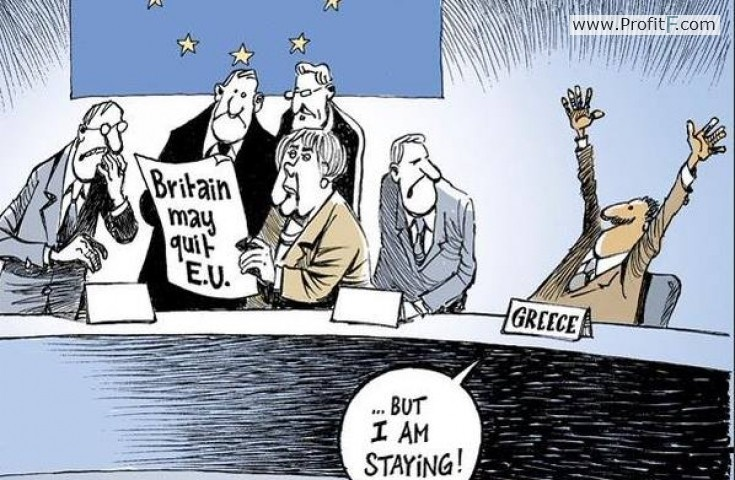
And of course, Britain is planning to pull out. The cartoon shows the EU under stress.
I was never too surprised about the “Brexit” movement because I have been listening to British EU complaints for 50 years mostly associated with all the crazy regulations that the EU passes each year.
How about regulations to ensure both bananas and cucumbers are not too curvy. And how about regulations to prevent people from eating their pet horses. The Belgians love their horse meat. 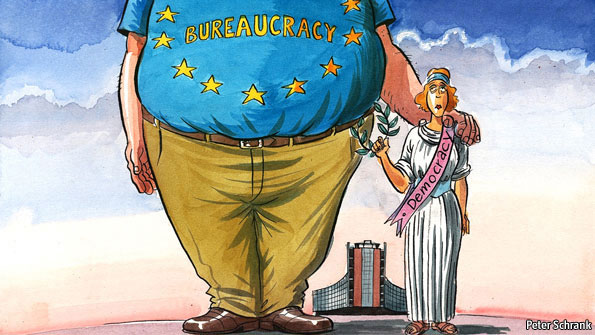 The biggest complaint by the Brits is that European bureaucrats approve all these crazy regulations because they know their fellow civil servants back home do not fully enforce them. But, the Brits do.
I love Europe, their history and their culture. But they are a society that is run by bureaucrats. It would be difficult trying to run a business in Europe after living in the “wild west high tech” kind of economy and society that has evolved in North America.
So many employees in Europe are contract employees because governments make it so hard for employers to fire an employee. Actually, it is often easier to fire a spouse than an employee in Europe.
And if things don’t change the EU will stagnate. Neither companies or countries can stand still.
That’s the way I see it anyways.
05-04 EU
(blank) » John Bulloch » 25 Quirky Opinions » 05 Globalism »
The EU is the German Empire. But an economic union run by bureaucrats.