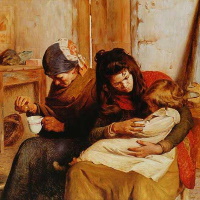
 We were in Santiago, Chile in February 2009 and waiting in our hotel for the flight home after a cruise to the Antarctic. And a lady in our group fell and broke her elbow. The cruise line rushed her to a “clinica” or private hospital. This was my first exposure to what is called two-tier medicine. The hospital was like a five-star hotel. And attached is a famous Chilean painting of a sick child that could be seen on one of the walls.
Now in 2020 with the world dealing with a global pandemic, the issue of single or two tiered health care is front and centre. In both Spain and Ireland, the governments have nationalized the private hospitals. It is a natural response to a health crisis that impacts everyone. And the long line-ups at the public hospitals could not be tolerated politically.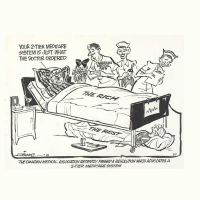 We have had public debates in Canada over two-tier medicine, and to me the debate is not as ugly as the cartoon. It means wealthier people paying twice for medical coverage. Taxation to fund the public system, and private insurance to pay for the private system. Private health care is an expensive way to avoid line-ups. In Chile, only 18% of the public use the private system.
But anticipate some form of nationalization or public support for the production of vaccines, medicines and personal protection equipment, all related to the Coronavirus, and the world’s dependence on China for supplies.
Unfortunately, the national economic crisis associated with the pandemic impacts a lot of strategic sectors. So anticipate either nationalization or capitalization of key industries, like national airlines. The term capitalization usually refers to national governments providing capital to private companies in exchange for shares.
In nations like France, where governments already own stakes in major companies like Airbus SE, Renault and Air France-KLM, additional public financing is a question of protecting their assets.
The argument against nationalization is that decisions made about the proper allocation of resources are more often political rather than economic. That is why so many nationalized industries are money-losers.
And in nations in Europe with high levels of taxation, assume their system is more about politics than economics. I questioned a Swedish colleague about the high levels of taxation, and he said that with three daughters getting free education through university, he was a pragmatic, heavily taxed winner.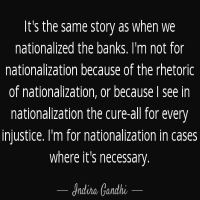 The statement made by Indira Gandihi, former Prime Minister of India, is very pragmatic and the basic philosophy of most of the western governments.
It would certainly be the basic thinking behind Canada’s decision to nationalize the Trans Canada Pipeline. “Not necessarily nationalization, but nationalization if necessary.” It was something that was considered to be in the national interest but not proceeding because of inter-provincial squabbling.
The world is being made comfortable with strong central governments acting in response to the Coronavirus. Whether it is nationalization, wage subsidies, capitalization, support for small business or whatever. Bernie Sanders the self-proclaimed social democrat and presidential candidate must be laughing.
And what makes it all acceptable to the political left and the political right is that no one can really figure out what is economics and what is politics.
02-01 Nationalization
(blank) » John Bulloch » 24 Quirky Economics » 02 Countries »
The nationalization of private hospitals and other forms of national support will give nations more control over their public health systems.