My memories of the Marshall and Solomon Islands are from old WW2 movies, showing US troops driving Japanese forces off the Islands and back to their homeland. 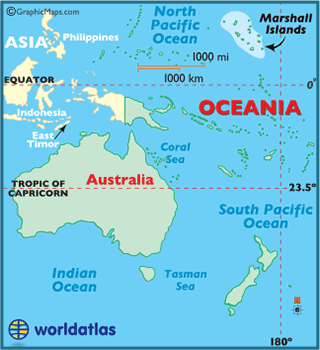 Todays drama is climate change and whether these islands can survive the rising oceans. The map shows the location of the Marshall Islands relative to Australia. Obviously, if these islands have no future, Australia will become the destination for millions of refugees.
This is going to be the cause of some nasty Australian politics. But global dislocation and emigration linked to climate change will be nasty politics for all the developed nations.
What are called atoll nations are islands that are the tops of old volcanoes. Most are low lying and threatened by climate change. In a sense they are the “canaries in the coal mine”. 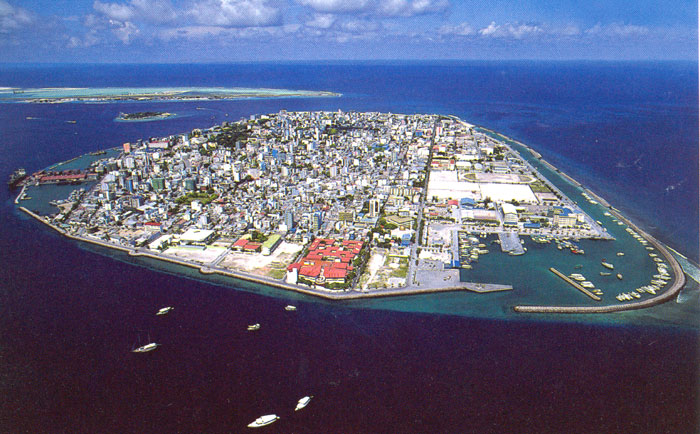 Apparently, there are about 700 populated island atolls in the Pacific and Indian Oceans. The Maldives near India are the lowest lying lands in the world and the most threatened. Apparently, 60% of the 1200 islands that make up the Maldives are only a meter above sea level. The photo shows the island capital of Male, surrounded by walls.
The tough issue for all the island atolls is determining which of their islands are worth saving in terms of walls and fresh water.
The immediate threat is high ocean levels and storms that send waves of water into these islands. This is salt water that is polluting aquifers that provide needed fresh water for drinking and agriculture. 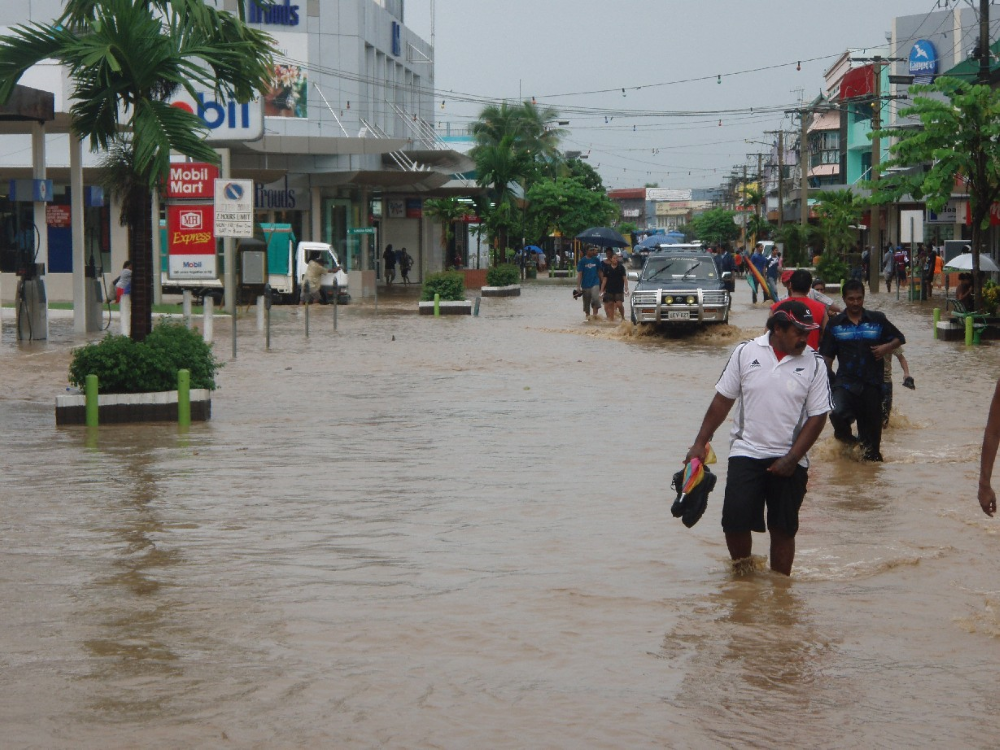 So, climate change impacts are already being felt. The photo shows what the main street of Male looks like after a storm.
Reading papers from prestigious climate conferences, the worst prediction is that the Atoll islands will become uninhabitable within ten years. And the biggest threat will be the shortage of fresh water, not the rising oceans.
01-07 The Atoll Nations
(blank) » John Bulloch » 20 Quirky Climate » 01 Real Quirky »
If the Marshall Islands are abandoned because of rising oceans and shortages of fresh water, millions will want to move to Australia.