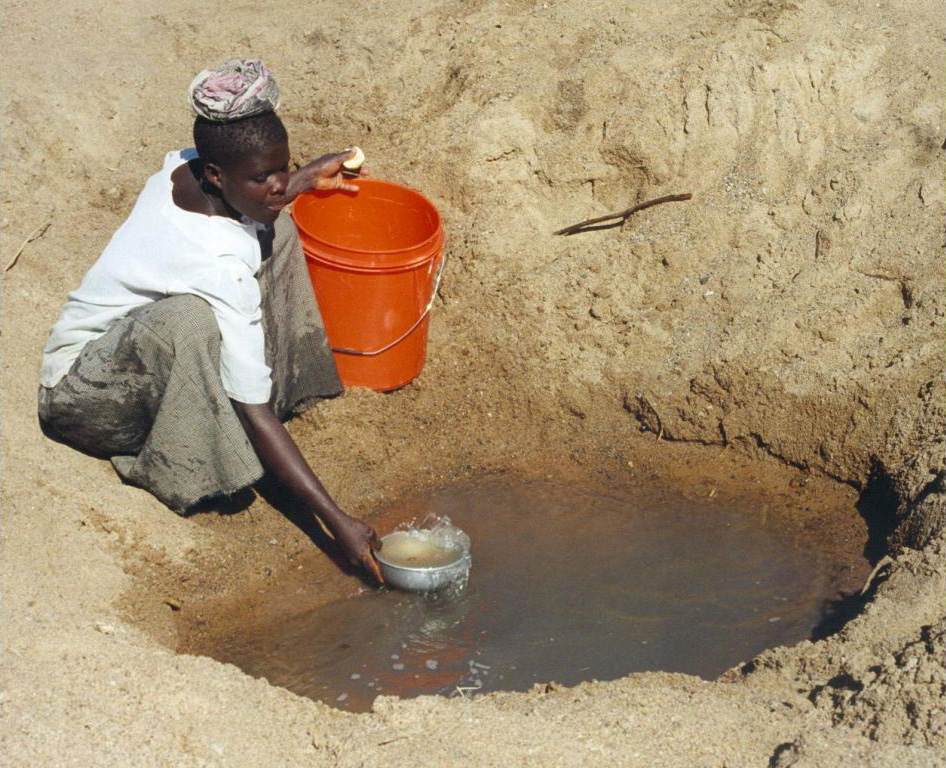
You have heard the expression that a picture is worth a thousand words. Well the photo of a woman from the Mwamanougu village in Tanzania drawing water from the dry sand of a river bottom tells you the real story of water scarcity. And usually this kind of water source is polluted.
Without getting techy, it is obvious that all water scarcity is not about natural physical scarcity linked to things like drought. It is more likely about people lacking the resources to exploit potential sources of water through drilling to access what they call ground water in aquifers, or drawing water in pipes from rivers or lakes, from what is called surface water.
It is hard to think of any problem that will compare to water shortages as we try to look to the future. In more simple terms, water shortages translate into poverty, and poverty translates into conflict. Look for water and you often find guns. Controlling water is a source of power when water is scarce.
The great unanswered debate is how much more serious water scarcity will become as our climate becomes hotter over time. I live under the assumption that climate change is real and that what we are doing about it is mostly politics. And politics is about perception and not reality.
Over the years as an active participant in the International Small Business Congress, there have been serious debates over the economics of massive dam projects designed to divert or store water for agriculture and domestic use compared to the economics of large numbers of smaller projects designed to use water more efficiently,
Things like “aqua” this and “aqua” that which is about using water to grow fish and vegetables together. Good old fish “poo” serves as the natural fertilizer. It was called “alternatives to field-based farming”. And these alternatives use about half the consumption of water.
What makes the issue of water scarcity everyone’s business is that it is not a plague of the most undeveloped societies. It is instead a problem of crisis proportions for over 40 nations.
And getting close to home, California continuously suffers from droughts and they are the seventh largest economy in the world. In Canada, we rely on California for a big part of our supply of fruits and nuts.
I remember with humour my brother calling me from California during the drought of the 1970s. “John”, he said, “we flush our toilets once a day, we can’t water our lawns or wash our cars, and we take quickie showers every second day. And out water meters are being monitored every week.”
In recent years, I have been spending the winters in California, and have become involved in the debate about water scarcity. So educational to discover that part of the problem is the lack of snowfall in the mountains, which means insufficient water flowing into the Colorado River.
And how about the debate re the growth of nuts like almonds that require so much water. Apparently, cotton is another crop that uses a lot of water. Even restaurants are told not to serve water unless asked.
It is not hard to predict people in affluent nations collecting rainwater in barrels that flows from roof tops and using it for watering their flowers or their grass.
I remember seeing farms in Switzerland in 1993 with what they called “rain catchment systems”. And Switzerland like Canada is a nation with huge surpluses of water. But catching and storing rainwater is about efficiency. And the Swiss are efficient in everything they do.
Surfing the web, looking for market-based solutions to water scarcity around the world, I was intrigued by the promotion of a water filter straw at waterislife.com. It is a water purifier that children can carry around their neck. It is about saving lives from waterborne bacteria and viruses. The filter acts like a straw.
It is a great emergency solution until a community can develop a safe source of drinkable water.
But back home, the solutions to water scarcity are going to be simple. It will be about charging a lot more for our drinking water. Water is probably the most under-priced of all resources.
14-02 Scarcity
(blank) » John Bulloch » 19 Global Issues » 08 Water »