It was in the fall of 1978 that Premier Alex Campbell of Prince Edward Island invited me to meet with his full cabinet to discuss small scale development initiatives.
And while meeting with his cabinet colleagues we all enjoyed a meal of fresh lobster. How many people realize what a magical small province we enjoy in what we call PEI.
After the meeting I was invited to visit their “home of the future” which was using all the latest technologies to provide the necessities of life. I never forgot that experience.
Besides the wind and solar technologies which are at the centre of the alternate technology world of today, what I was astounded to see was a tank located in their kitchen three feet in diameter and six feet tall that was growing Tilapia for home consumption.
The water in the tank was being continuously circulated and filtered. About thirty or forty fish of all sizes were growing in the tank.
This, the guide explained, was how people will help feed themselves in the future.
The futuristic residence was also growing various types of herbs and vegetables in a greenhouse using fertilized water from the fish tank.
The whole project was designed to grow food without fossil fuels, pesticides or fertilizer. And we are talking about the late 1970s. Far out.
It was an interesting lesson on how thoughtful leaders can focus public attention on challenges that have a way of travelling around the world like diseases.
Here is an example. Social and political instability related to the population dynamics of underdeveloped nations are often the sources of conflict which impact the investment and trade of developed nations.
There is a political consensus that where you have over-population and societies that cannot provide its people with the necessities of life you also have not just a lack of development, but the wrong kind of development.
And what makes this issue more difficult is that the nature of what is appropriate development is different everywhere. Is it a nation’s poor education and health system? Is it a lack of resources? Bloody complex issue.
The only issue I could get my head around was the requirement that under-developed societies become self-sufficient in food production.
Despite the hundreds of millions around the world that cannot feed themselves I never saw much long-term value in shipping surplus food from developed to underdeveloped nations.
So, Canada, for example, sends wheat to an African nation that does not have the climate to produce wheat. Does that look like a long-term solution to the problem of starving people?
And it was hard seeing a solution to the development needs of poor societies by raising cattle. Not the most efficient way to produce protein. But lots of poor families live off the milk of their family cow.
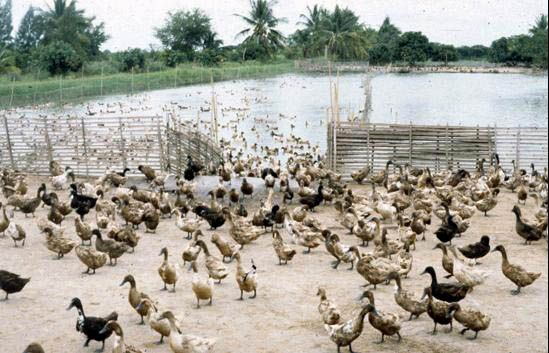
During our tour of China in 1985 my wife and I saw farms in rural China that were engaged in combination duck and fish farming. The photo above is not untypical.
There would be several hundred ducks raised next to a huge fish farm that used the duck poo as its food source. Apparently, it is of high quality. The fish do not require any kind of additional feed. The fish we saw in China were called “Silver Carp”.
And the duck poo not only feeds the fish but nourishes plants on the bottom of the pond that help feed the ducks. The only input-cost is some form of supplemental duck feed.
And, of course, a duck will lay over 200 eggs a year, so between the fish, the eggs and the duck meat you have a viable economic protein machine.
Now we have one solution to feeding the world’s poor, provided, of course, there is an available source of fresh water. And again, no need to import either fertilizer or insecticides.
I live in an area that produces massive amounts of corn and soybeans. You get the impression without being an expert that we could keep producing food regardless of the growth in the world’s population.
But the problem is distribution rather than development. The challenge is growing the food where people live.
That’s the way I see it anyways.
13-03 Development
(blank) » John Bulloch » 19 Global Issues » 07 Population »