How would it feel as a citizen of Australia to have the small island nations of the Pacific blame Australia’s massive coal industry for the climate change forces that are threatening their future?
I am talking about island nations that we heard about during WW2, like the Maldives and the Marshall Islands. And then there is Fiji and their surrounding islands. The problem is rising sea levels and violent weather changes that threaten their existence.
It is all very awkward, messy and confusing.
Let’s try firstly to understand the nature of coal as an industry in Australia. And in global terms Australia is a coal giant. Australia is to coal what Saudi Arabia is to crude oil.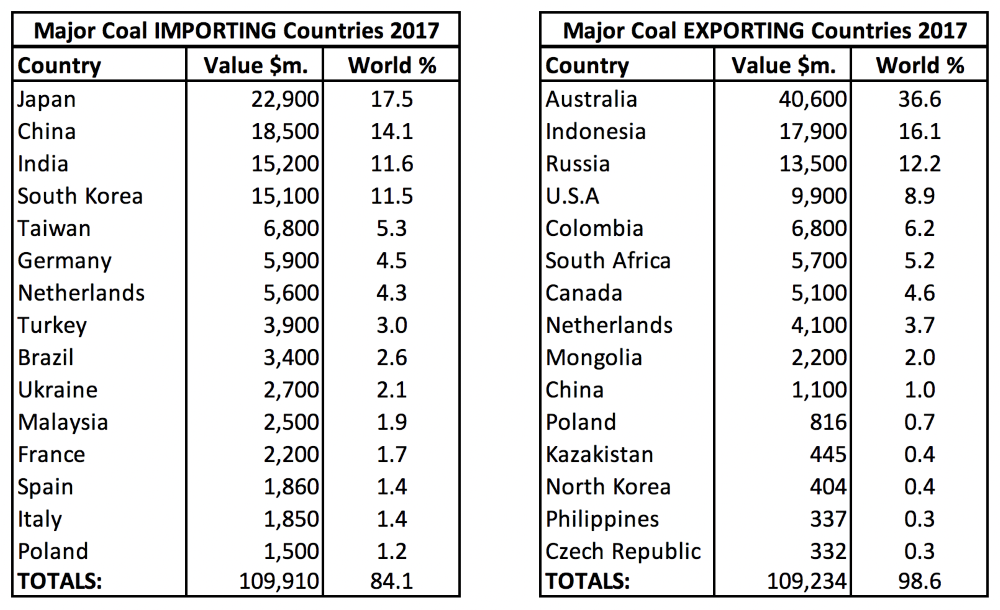 The graph shows the big exporters and importers of coal, and for Australia it is a $40 billion business. And until those large importers of coal, like Japan, India, China and South Korea, find alternative energy sources, Australia will continue to be a coal giant. And those cheaper alternatives will not be natural gas that is available in the US and Canada. It will be wind and solar.
Australian coal is produced in many parts of the nation but the major mining and exporting takes place in the states of Queensland and New South Wales. It is like Alberta and Saskatchewan in Canada.
This means that nations like Australia and Canada face difficult political conflicts fighting climate change and trying to protect, at the same time, the jobs of people who make their living in the fossil fuel industry.
What is so interesting about coal in Australia, despite its size, is that it cannot compete with cheaper renewables. This phenomenon is happening all around the world. And at some point, coal mines will just go bankrupt.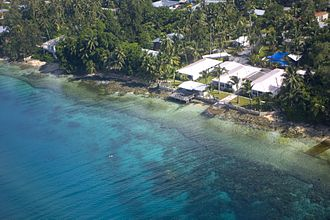 The photo of Majuro in the Marshall islands show, on a calm day, how the ocean levels are rising as a result of climate change. Not just ice melting in the Arctic and Antarctic, but water expanding because it is warmer.
The Marshall Islands are an archipelago and are made up of hundreds of small islands of which some have already completely disappeared. But without disappearing, an island can become inhabitable because rising seawater makes the soil too saline to grow crops. A whole culture is under threat in the South Pacific.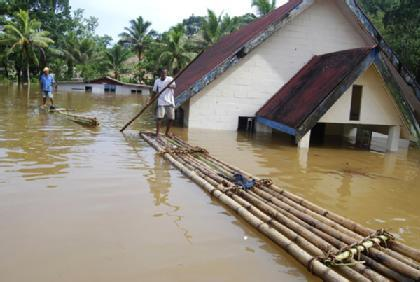 Another great photo shows the impact of extreme weather in Fiji, which is also the consequence of climate change. During my visit to Fiji in the early 1980s I was impressed by the planting of a million trees to redevelop their economy. It would be called a climate change strategy today because trees absorb carbon dioxide and expel oxygen.
I feel sorry for Aussies facing the decline of one of their largest industries, and at the same time taking a political hit from all the south Pacific islands facing extinction.
06-05 Australia
(blank) » John Bulloch » 19 Global Issues » 03a Coal »