The “Conservative” argument seems to go like this: “Why are we shutting down our coal-powered generating stations when countries like India can’t build coal-fired power plants fast enough?”
And the “Liberal” argument is quite different: “Developed nations have prospered using fossil fuels and have a moral imperative to retire their coal-fired power plants to help control climate change.”
The reality is that there would not be an international agreement to reduce the production of greenhouse gases if the developed nations did not recognize the need for developing nations to provide the necessary energy to electrify their societies. In India, for example, there still is over a million homes without electricity.
And, for nations like India, the necessary energy will come from coal whether produced locally or imported.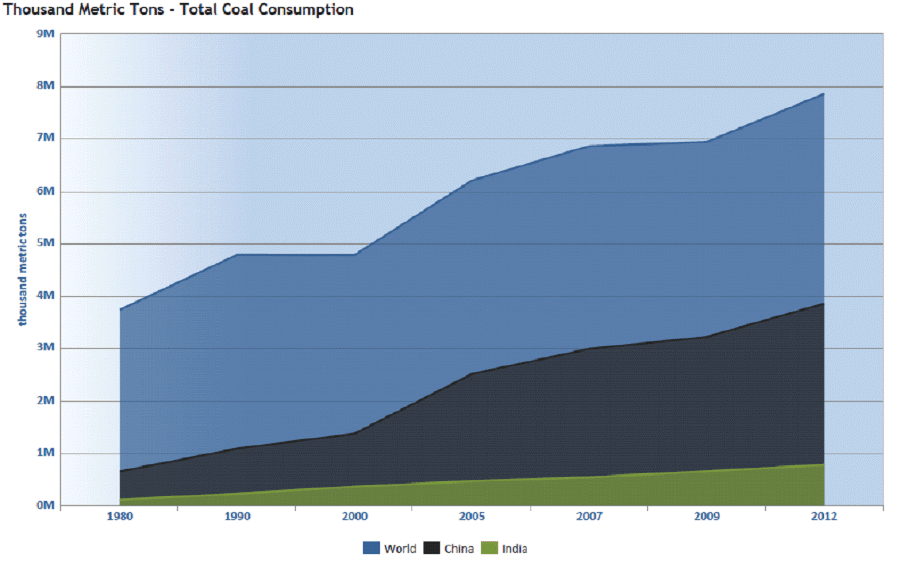 The graph tells the story. In terms of the growth in the consumption of coal, more than half of the global demand is coming from China and India. And in India what they call an energy crisis is the shortage of coal.
My experience with development in India is that there is a massive regulatory burden for private companies to overcome. And if they need export and import permits, for example, this usually requires the payment of a bribe to some government functionary.
So, attempts to privatize the production of coal is not likely to solve shortages. Today, the production of coal in India is managed for the most part by Coal India Ltd or CIL, which is owned by the state. And, like China, the production of coal for fueling its power plants also means filling the air with all kinds of sulphur and nitrogen oxides which not only create smog and acid rain, but damage to people’s health.
It is a matter of public record that seven of the ten worst cities in the world for pollution are in India. And air pollution kills over a million Indians each year.
During my research it became obvious that India and China are working from the same playbook. Make their coal fired power plants more efficient. This means less carbon monoxide, more carbon dioxide and more heat.
The interesting element associated with the production and consumption of coal is the high cost of transportation with coal mining located in remote areas in the north.
This is what will make the future of solar in India so powerful. Producing the power where it is needed. And employing renewables not because they are green but because they are cheaper.
06-04 India
(blank) » John Bulloch » 19 Global Issues » 03a Coal »