As a boy, I remember my father shovelling coal into a hopper in our basement and putting the ash into a heavy metal drum. There were no recreation rooms in those days.
After the war, our family went to Belfast to visit our grandparents and there I got another coal education..
Our grandfather went up and down the streets late at night scooping up small pieces of hard, black coal that had fallen off the trucks. That coal heated one room of the home, where we all gathered to keep warm. This was hard anthracite coal which came from England.
But there was also a huge fireplace in the kitchen that was used once a week when everyone had their weekly bath. Yes, in the same tub of water. It was heated with peat, which is plentiful in Ireland. And the trick was to direct the hot exhaust fumes going up the chimney around a tank full of water.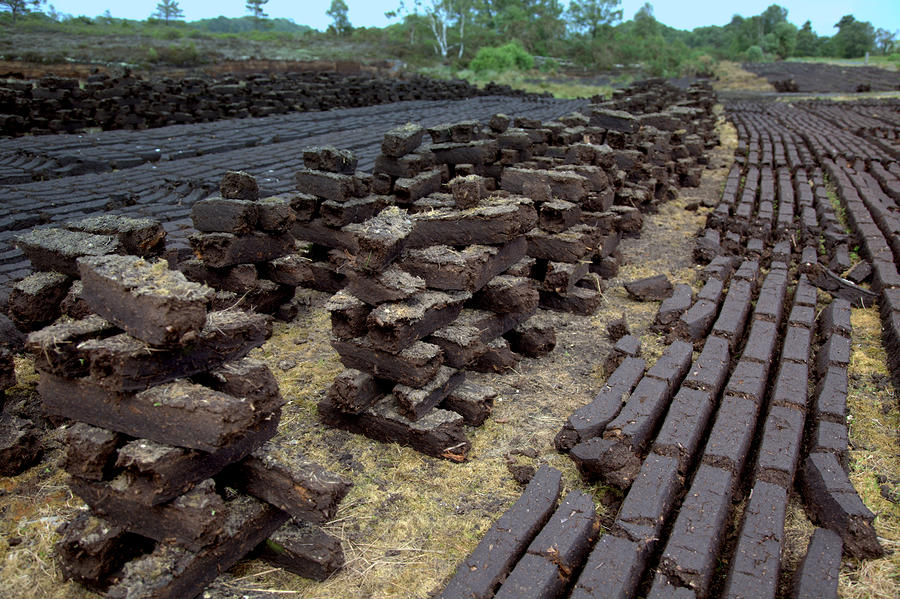 The photo shows what they call a Peat Bog. The peat is used for heat, but it is also great for growing mushrooms.
 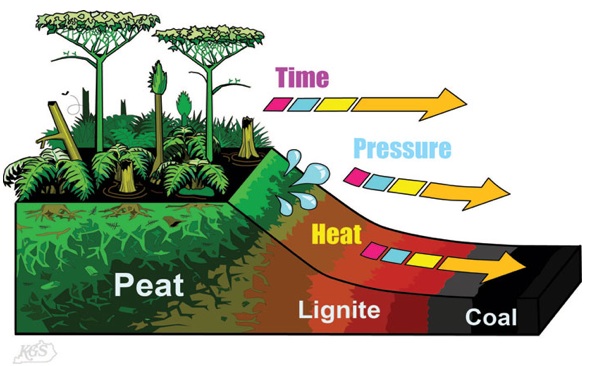 Without getting technical, things like peat and lignite are softer forms of coal. And when you get to hard coal you have bituminous coals and hard shiny anthracite. It is all about how hard they are, how much carbon they contain, and their potential heat content.
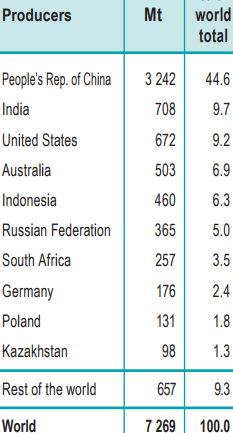 Something like 70 nations of the world have coal reserves that are being exploited in some manner. The graph shows the major producers.
And when you see people in Beijing wearing face masks to protect them from the pollutants released from burning coal, you realize that the goodies in the exhaust are much nastier than the CO2.
During my early life as an engineer, I worked with heavy industry and saw a type of bituminous coal, called metallurgical coal, turned into coke for making steel. And I saw massive amounts of coal used in the production of cement. It is not always easy to find replacements for coal.
But I also saw lots of applications where coal and heavy fuel oils were used to generate steam for producing electricity. And as these power plants were upgraded or replaced, the preferred fuel option was natural gas. If available, and if cheaper.
The big news today, with the advances in the technologies associated with renewables, is that there is a “green” alternative to coal. Well, not really a green alternative. An economic alternative.
The future magic, in my judgement, will be merging good economics with good politics. If it is just politics driving climate change, then every time we close a coal mine in a developed nation, they will open one in an undeveloped nation.
We need to remember that there are more than a billion people around the world who want electricity that do not care what energy source is used.
06-01 Understanding
(blank) » John Bulloch » 19 Global Issues » 03a Coal »