It is one thing to understand the issue of energy shortages over time. Massive demands for energy not matched by increasing supplies. But what about shortages of food and water. The linkage is population growth.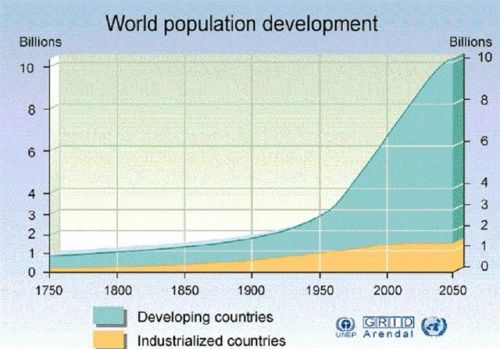 The chart shows clearly the basis for the challenge facing mankind. It is population growth from present levels of about 7 billion to about 10 billion by 2050. But what is most important about population growth is that it will be found in the less developed areas of the world.
We are talking about nations like India, and nations in Africa and Latin America. What makes the energy crisis such a threat is that these undeveloped areas of the world want the standard of living presently enjoyed by the more prosperous nations of Europe and North America. They all watch TV.
To put it simply: A third of the world wants to industrialize. They are not satisfied with the status quo. Today, something like 1.6 billion people do not have electricity and something like 3 billion people still heat their homes and cook their food using wood, dung and coal.
So how in the world are we going to bring climate change under control if there is going to be an increasing demand for energy.
Certainly, as the price of crude oil rises over the next 25 years, there will be an explosion of investment in renewables like nuclear, wind and solar. But, unfortunately, as the temperatures of the world increase the demand for energy to cool our homes will exceed the energy required to heat our homes.
There are two things that can happen. One is that the climate issue becomes a real crisis, like something experienced by old folks like me during WW2. At that time, absolutely everyone was doing something for the war effort.
And in a time of crisis, politicians will make bold moves like outlaw the internal combustion engines for cars and buses. And remove subsidies for fossil fuels and create subsidies for renewables.
The other thing that can happen is a technological break-through in the development of renewable energy. And that is happening as researchers around the world experiment with new materials and new technologies for manufacturing solar cells.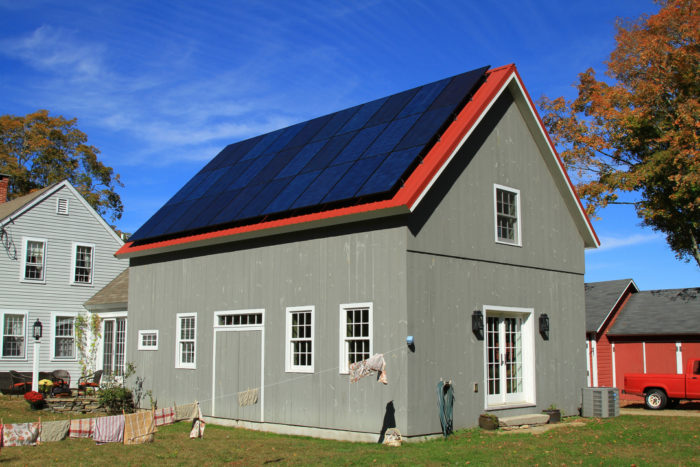 The photo is of a typical home with solar panels on the south side. But we also have solar roofing tiles, solar heaters, solar on the rooves of cars and buses, solar clothing and solar sidewalks. And thin solar material that can be printed on a piece of paper. Massive cost reductions are ahead.
It will be the world adapting to solar energy because it is cheaper, not because it is green that will save the world. Unsubsidized solar energy that is cheaper than the grid is our future.
02-02 Linkages
(blank) » John Bulloch » 19 Global Issues » 02 The Crisis »