It was a third-year engineering course in metallurgy and the discussion was about copper and its many alloys. Like copper and zinc gives you brass. And copper and tin gives you bronze.
Someone asked the professor if there is a danger that we could run out of copper. And his response was an early lesson in thinking like an engineer. He said as engineers the question you ask is what is the appropriate response as the price of copper raises to meet an increase in demand.
He then had us focusing on copper deposits that would be economical if the price of copper increases. And he also had us discussing alternatives like aluminium, as the price of copper raises. Always focus on price was his advice.
Son of a gun, that must have happened, because 25 years later my daughter bought a house with aluminium wiring.
All my life I have been a product of my education as an engineer and have been puzzled when politics tries to override science. In complex issues like climate change both science and politics are important.
But appealing to people’s better nature in promoting something like energy conservation only goes so far. What is more important is something as basic as the cost of lithium batteries used in electric cars. And what about the cost of wind and solar energy in providing electrical energy.
My wife and I went to an auto show in San Jose in 2017 and attended a lecture from a consultant to the auto industry. The conclusion for me was positive in the sense that technology was starting to look like a partial solution to climate change.
It seemed that all the auto companies were bringing either a hybrid (combination battery electric car with a small internal combustion engine as back-up) on to the market, or a pure battery electric vehicle.
And, according to the lecturer, the cost of lithium batteries has fallen in half in the last five years. And they are going to get cheaper.
One of the members of the audience asked if governments will eventually outlaw internal combustion engines. He said France, India and Norway are already planning to phase out the traditional gasoline burning cars, but the internal combustion engine will die a natural death because it is being replaced by better technology.
And better technology will always win over the environment. Vehicles that are dead quiet, with high acceleration, cheaper to maintain, cheaper to fuel and on and on went the pitch. Impressive though. Yes, societies are madly building electrical fueling stations.
But of course, the power comes from natural gas burned at power plants, but with less “poo” thrown into the atmosphere compared to automobile exhaust.
And it is the same story with the technological advances in the design and production of solar panels and wind turbines. Love technologies where you can produce energy close to where you use it.
I spent a summer as an engineering student working at Ontario Hydro next to a room full of electrical engineers focused on all the technical issues associated with sending electrical power from the source to the end user.
We are now at the point where electrical power generated by solar and wind will compete with electrical power generated by nuclear and hydro. Now this is a big deal. Something global and transformational is underway.
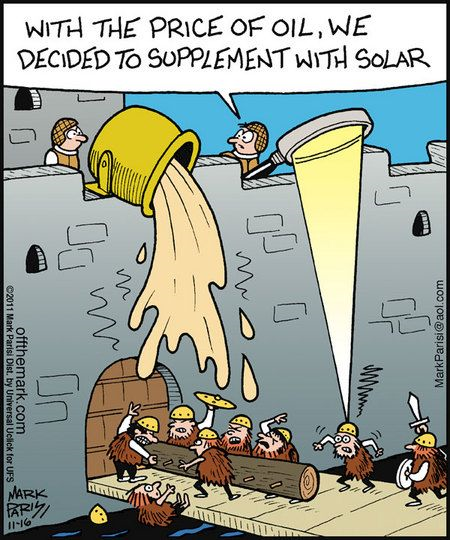
The cartoon is a hoot, but points to the reality ahead of us when societies switch to renewable energy sources. Advancing technologies will make them cheaper.
07-02 Technology
(blank) » John Bulloch » 19 Global Issues » 01 Climate Change »