The Eiffel Tower in Paris is about 1063 feet tall. Well, a new wind turbine manufactured by General Electric in France is about 853 feet tall.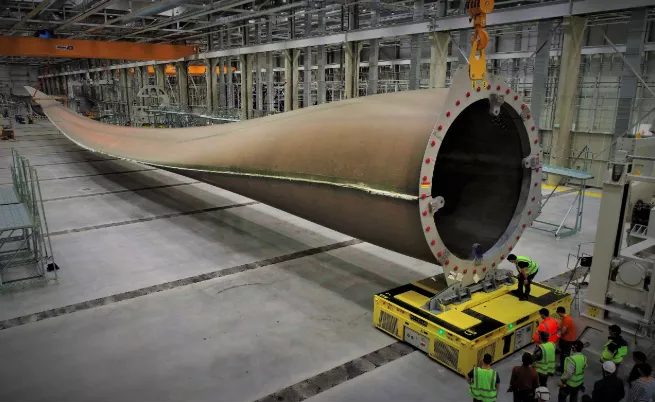 The attached photo shows one of their turbine blades being manufactured in its plant in Cherbourg. Think of something the length of a football field.
During my political years when I served on an advisory committee to the Prime Minister of Canada, the role these global companies filled was telling the government their long-term thinking. Large corporations do not invest a billion dollars without some sense of where things are going.
Governments on the other hand tend to focus on what is happening from one election cycle to the next.
So, if global companies are into the wind turbine business, assume they have a pretty good handle on where the technology and markets are headed.
General Electric is essentially telling the world that bigger is better, in terms of procuring electrical power from offshore turbines at the lowest cost. It is about bigger blades and blades up higher. It is about lower costs for building wind farms. It is about fewer turbines and faster installations.
So, here we have an American company with production facilities in France selling products to the world. Welcome to globalism.
And when we hear the American president challenging climate change, assume he is fronting for the oil and gas industry. No problem with that. Anytime big global issues are at stake, all the players hire the most professional lobbyists everywhere and not just the US. The global companies just work around the politics.
Nuclear, for example, won in France, but lost in Germany. Wind turbines won in Denmark and lost in Japan. But politics change and better technology always wins in the end.
During my quasi-political years, I was always interested in what was happening in Scandinavia. Swedes were Swedes. Norwegians were Norwegians. They were cultures where it was easier to build consensus and make changes. And they would do stuff before it was economical because of their left-wing ideology.
Today that means encouraging people to take trains rather than fly to cut back on the use of fossil fuels, even if it does not make economic sense.
But things like technology, public policy and politics are always intertwined.
And, listening to those promoting wind technology, oil is running out, coal is dirty, and fracking can contaminate ground water. And all fossil fuels add carbon dioxide to the atmosphere and trap heat. Not a bad argument, from a political perspective at least.
And one thing the world has is lots of wind. In theory, if wind farms in places like the North Atlantic were large enough wind could supply the world with electrical power.
But what is happening is more exciting. Nations around the world are accommodating the technology to meet their special needs. Floating wind turbines were the water is deep. New transmission technologies where the wind turbines are far from the markets. Small turbines for small markets.
What an exciting time for young engineers around the world. The future is in their hands.
04-05 The Future
(blank) » John Bulloch » 17 Energy » 04 Wind »