Only in Japan. A bus driver with a university degree in languages that also served as a tour guide. An example of Japanese productivity.
He told us during a 1986 tour of Japan that he had to promise his father that he would never live in a two-story home because of earthquakes. And that explained the sprawl that characterizes Tokyo.
Well, we have all heard of the Tohoku earthquake back in 2011 that damaged the nuclear power plant in Fukushima. A tragic event that gave imperative to the provision of future electrical energy using renewables like solar and wind.
Something that was noticeable back in 1986 was the pristine rural nature of Japan. Streets that were spotless. And an obsession with beauty and the protection of the environment. No surprise therefore that onshore wind turbines have had no political appeal except in the seriously remote areas of the country.
Until the nuclear disaster in 2011, the major sources for generating electrical power were fossil fuels and nuclear. And there seemed to be no interest in wind power. Such a surprise for a nation with massive shorelines and locations for offshore wind turbines.
The big issue was the deep water. Something I noticed in Maui which like all the Hawaiian Islands is merely the top of a volcanic mountain. And a short distance from shore the bottom drops to something like 30,000 feet. And, in comparison, the shorelines in Denmark are relatively shallow even a mile from shore.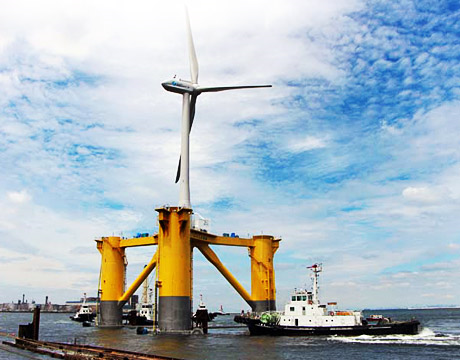 So what have we got in Japan? Research into large floating offshore wind turbines that stay relatively level even in rough weather. The photo shows one under construction. There research is going to make wind energy viable in a lot of nations with deep water offshore locations
My experience with my Japanese colleagues is that they do not make decisions until everyone is onboard. It is a consensus culture. This means that Japan is more of a clever follower than a risk-taking leader. But they are good at taking technologies and improving on them. And whatever they do, they do well.
Today most of their wind turbines are imported from nations like Denmark. And less than 2% of their electrical energy is developed using wind turbines. The global number is around 3%. And to make things even more complex, their large power companies do not do anything without the approval of the government. No wonder they are so far behind the rest of the world.
However, when consensus is reached on using wind technology to reach its 2030 and 2050 targets for the removal of fossil fuels it will become a government-business partnership initiative. And suddenly those power companies will get access to cheap money. And new wind technologies will start showing up. It is just the Japanese way.
04-03 Japan
(blank) » John Bulloch » 17 Energy » 04 Wind »