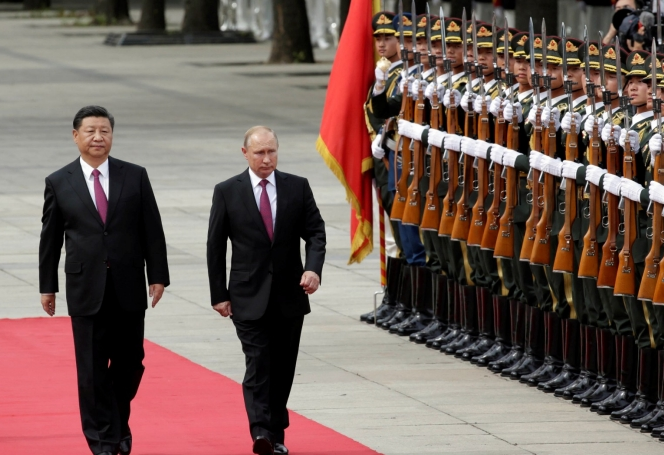
 The diplomatic challenge facing the United States is preventing China and Russia from becoming real allies in a military, economic, political and diplomatic sense. In the world of diplomacy, everyone speaks in code, and terms like “economic partnership” are not threatening but terms like “alliance” are.
But preventing this potential alliance of cold war foes, the US has a real conundrum. Do they become friends with Russia that tinkered in its election and invaded the Crimea? Or do they become friends with China, a nation that seeks to replace the US as the dominant political power in the world.
It would be my judgement call that the US cold war with China has already been lost before the public really knows one exists. It is called winning without conflict. They do it by investing in ports and railways throughout the world to control access to resources and markets. And they use their trade surpluses to invest in US treasury bills to keep the dollar strong and US exports weak. We are talking about China owning a trillion dollars in US treasury bonds.
In terms of cyber warfare, every nation is engaged, including the US. The fact that Russia was caught means they wanted to be caught. They wanted the world to know that they are still powerful.
To be more specific, every nation engages in nasty stuff to protect its security or damage someone else’s security, but they seldom get caught because these things are done in secrecy so those doing the dirty deed do not know who they are working for. “A” hires “B” who hires “C” who hires “D”. That kind of thing.
And in terms of the annexation of Crimea, territory that was part of Ukraine, I am on Russia’s side. When my wife and I toured the Soviet Union in 1987, we spent three days in Odessa, and got a special education from our guide who was a professor of English at Moscow University and a last-minute fill in for the formal state tour guide.
She told us then that Crimea was more Russian than Ukrainian with the majority population Russian speaking. She said her university colleagues believed the transfer of Crimea to Ukraine was a strategic mistake, because the Crimea was the island-home of Russia’s Baltic Fleet.
Putin in the annexation of Crimea, only did what President Reagan did when he invaded Grenada. Protect the national interest.
Now, being specific about Russia-US relations, Russia is conflicted over control of the Middle East. Lots of proxy wars and tensions in places like Syria and Lebanon.
And, China is involved in a range of conflicts with the United States in the whole Indo-Pacific region with a fight over control of things like fishing rights and oil and natural gas. But its subtle investment strategy, particularly, in the South China Sea is enabling China to quietly dilute American influence.
Better for the US to have one enemy or friendly enemy rather than two. Better to make diplomatic peace with strategic adversaries than engage in forms of conflict like cyber warfare, where nobody wins.
What is particularly frightening dealing with centrally controlled Communist states, is their ability to harness all kinds of everyday citizenry. In democracies this kind of activity is done through formal contracts enforceable in the courts. Not so in Russia and China. All citizens need to know is what the leader wants you to think and do. And they can get the message from a political address or from the state-owned media.
So, our friends in China and Russia can say they are not really engaged in anything nasty while the whole nation is goose-stepping in unison.
05-03 The US Conundrum
(blank) » John Bulloch » 16 Cold Wars » 05 Diplomacy »