It was 9:30 in the morning in Beijing in the fall of 1985, and I am talking with a young student who wanted to practice his English. I gave him a quality Canada pin, which was made in Taiwan. Two hours later I bumped into him again. He was waiting at another tourist destination hoping to find me and secure a pin for his girl friend.
Now it is two years later and during a visit to the former Soviet Union, I find the only Russians speaking English work in government stores, and to my dismay, I discovered that I was being cheated when making change.
Putting these experiences together with all the other things I learned, it would have been difficult to see Russia and China as potential partners in any way.
Russia was inward looking, insecure, bureaucratic and with its best people focused on the military and space. China, on the other hand, was technological, entrepreneurial and international and focused on manufacturing consumer goods.
And to complicate things, both Russia and China were competing diplomatically as leaders of the Communist world, each with their own spheres of influence.
The important diplomatic event in history was in 1969. It started with ping pong, then Kissinger visiting China, followed by President Nixon meeting with Chairman Mao.
Beijing then became the recognized capital of China replacing Taipei. And China starts to trade with the world. What was not told publicly, at the time, was that the Nixon/Mao initiative was designed to keep China from becoming too closely aligned with Russia.
Well how things change. Now the closer relationship between China and Russia is based on mutual economic and political interests. Russian sells China $400 billion in natural gas and Russia imports consumer goods. And both Russia and China see the US as threatening their national interests.
China competes with the US over control of the South China Sea. And Russia is in conflict diplomatically with the US over the annexation of Crimea. 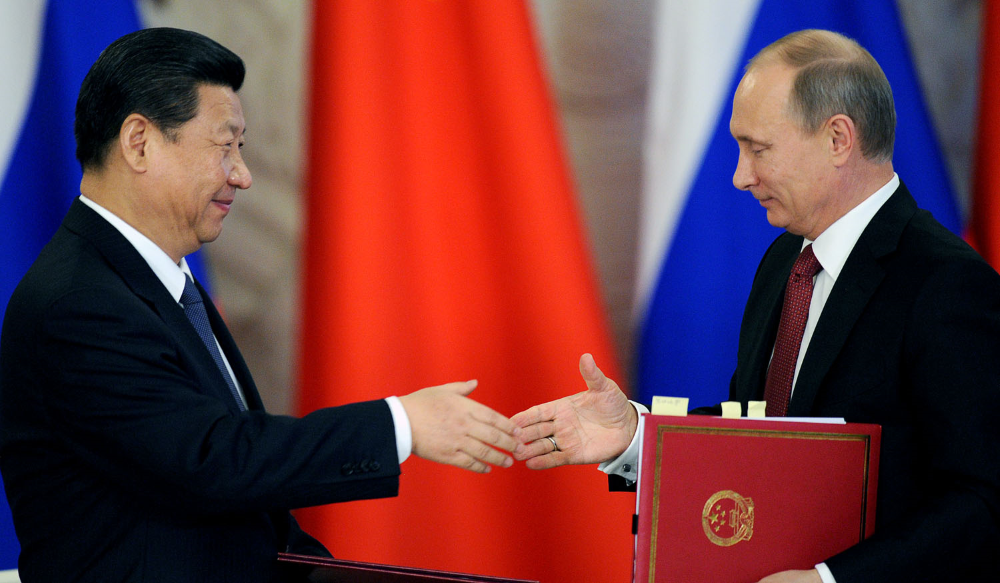 The publicly stated goal of the growing relationship between China and Russia is the creation of a multi-polar world in which world domination is shared by China and Russia, the EU or the German Empire, and the US. This realignment means tough decisions are ahead for Britain, Canada, Australia, New Zealand, Japan and India.
The driver of the multi-polar world, however, is not China and Russia but American isolationism, or Trumpism. Instead of building and strengthening the economic and political alliances built after WW2, the US has alienated all its allies in the West. These are the nations the US needs to confront not only China and Russia but proxy conflicts in places like Iran and Venezuela.
The US is in a cold war with both China and Russia, but the US public does not understand this reality. They think they are at war with impoverished Latin Americans fleeing poverty and persecution in their own countries.
05-02 China and Russia
(blank) » John Bulloch » 16 Cold Wars » 05 Diplomacy »