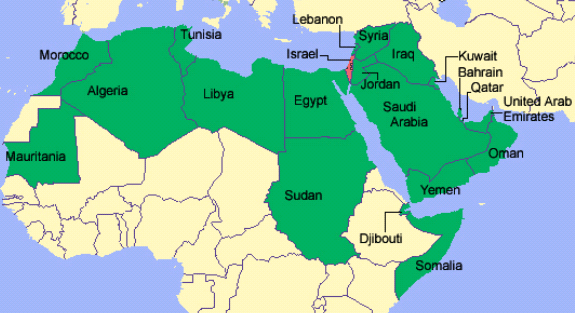
“A picture is worth a thousand words.” Well, the map of Africa and the Middle East gives you a sense of the size of the Arab world and the number of enemies Israel has faced since it became a state after the UN agreed in 1948 to the partition of Palestine.
This story will give you a sense of the politics of the Arab governments. It was in June of 1979 and a young 40 year-old Joe Clark became the Prime Minister of Canada pledging, amongst other things, to move the Canadian embassy from Tel Aviv to Jerusalem.
Well, when he was declared Prime Minister, all hell broke loose as the ambassadors of the Arab governments hit the new Prime Minister hard, threatening all kinds of repercussions. The most serious, of course, would be the loss of Saudi oil that was supplying eastern Canada. I know all the gruesome details of this crisis, because after the Clark government fell the following March, I hired Clark’s political advisor.
But what is even more interesting is that when President Trump made the same promise in the US presidential election of 2016 and followed through, there were only minor repercussions. No surprise that the Palestinian President Mahmoud Abbas cut off relations with Washington. But all the other major players, like Egypt and Saudi Arabia, were relatively moderate in their reaction.
What it told me as an observer of Israel and its relations with the Arab world, is that Israel has developed friendships with critical elements of the Arab world, what they call the Sunni nations. And I suppose it is also about common interests they have developed together over time. Like selling natural gas to Jordan and saving them hundreds of millions of dollars. And cooperating with Egypt and Saudi Arabia in a common defence against Iran, their mutual enemy.
I have always felt conflicted about the age-old problem of Israel and its Palestine neighbours. Something like a million inhabitants of the Gaza strip are people who used to live in what is now Israel. Their lives are hell, but will they ever make the compromises necessary to enjoy peace with Israel? Their problem is thinking the other Arab nations are their friends. Arab blood is not thicker than water.
But it goes back to the Arab nations that invaded Israel after partition. There were the forces of Egypt, Syria, Lebanon, Iraq and Jordan. How could they possibly lose that war? Lots of movies based on that drama.
It is all about Israel's strength and the Arab nation's weaknesses. Israelis are organized and self-disciplined, whereas the Arab nations were just the opposite. Kingdoms fighting each other. Armies poorly trained and equipped. Hard to believe they really fought for the Palestinians. More about what was good for them.
And in those days before the cold war, both Russia and the US were on the side of those who voted for the partition of Palestine. Russia helped Israel get weapons from Czechoslovakia. And the US provided all kinds of logistical support regarding intelligence and military advice.
If there is something that I have learned over the years, it is that people who are self-disciplined and organized are also multi-taskers. And for a society that is culturally self-disciplined and organized like Israel, they can be a world leader in technology and economic development, and at the same time a world leader in diplomacy and defence.
And each year as Israel gets stronger, Palestine becomes weaker as more and more Arab nations build partnerships with Israel to protect their friendship with the US. President Trump's relationship with Israel is not wishy-washy.
03-02 The Arab States
(blank) » John Bulloch » 12 Israel » 03 International »