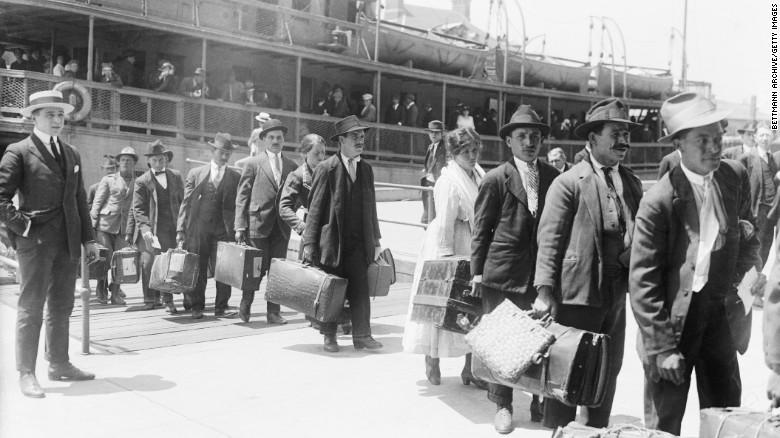
 My mother’s father arrived in Halifax from London in 1905 as an immigrant. He was born in Warsaw, Poland and moved to England after his mother died. He was only 17 and found work in Toronto as a bus boy in a restaurant. The photo could be immigrants in Halifax or New York.
My mother’s mother was born in Romania. She was smuggled out of the country and entered England as a refugee in 1900 with her mother and seven siblings. In England as a child she learned the language and a trade as an alteration tailor. She married at age 17 and her husband died of a burst appendix at age 18 while she was pregnant. She emigrated to the US and met my grandfather in New York when he was there on holiday. They married in the US and she came to Canada with her baby, who died of diphtheria.
These family stories are the stories of immigrants and the challenges they face trying to assimilate in a new country. Both my Jewish grandparents found friendships by shopping at the Kensington market in Toronto.
My father’s story was not much different. He came to Canada at age 20 in 1928 with his ticket paid for by the Canadian government for working a year on a farm outside Regina. The government’s immigration priority at that time was to populate Western Canada.
When he settled in Toronto, he felt quite at home because the largest immigrant population in Toronto at the time where Protestants from Northern Ireland. He even joined a club called the “Instonians”, made up of former students of the Royal Belfast Academic Institution.
Of all the public policy issues I found most significant during my quasi-political career, they were always associated with population demographics, immigration and refugee settlement. Population issues were about everything important: economic growth, social cohesion, politics and national security.
In my childhood, most of the immigrants came from Europe. And living in the immigrant district of Toronto, large numbers of Jewish immigrants arrived to escape the threat of Nazi Germany. Their children did not speak English.
Immigration in my childhood was about supporting economic growth after WW2, because Canada was underpopulated. And all the immigrants came from Europe.
Today the bulk of Canadian immigrants come from Asia, with large Indian populations in British Columbia and large Chinese populations in Toronto.  During my teaching years at the Ryerson University in Toronto, the student body was from across Canada but “Anglo-Saxon”. Today the student population is heavily dominated by Chinese students. The Chinese, like Chinese everywhere, are enormously adaptable and quickly blend into the local culture.
The US has different immigration challenges with large Hispanic populations from Central America entering the United States through Mexico. It is not Mexican immigration that is the problem because more Mexicans that were living in the US are returning to Mexico than Mexicans entering the United States. 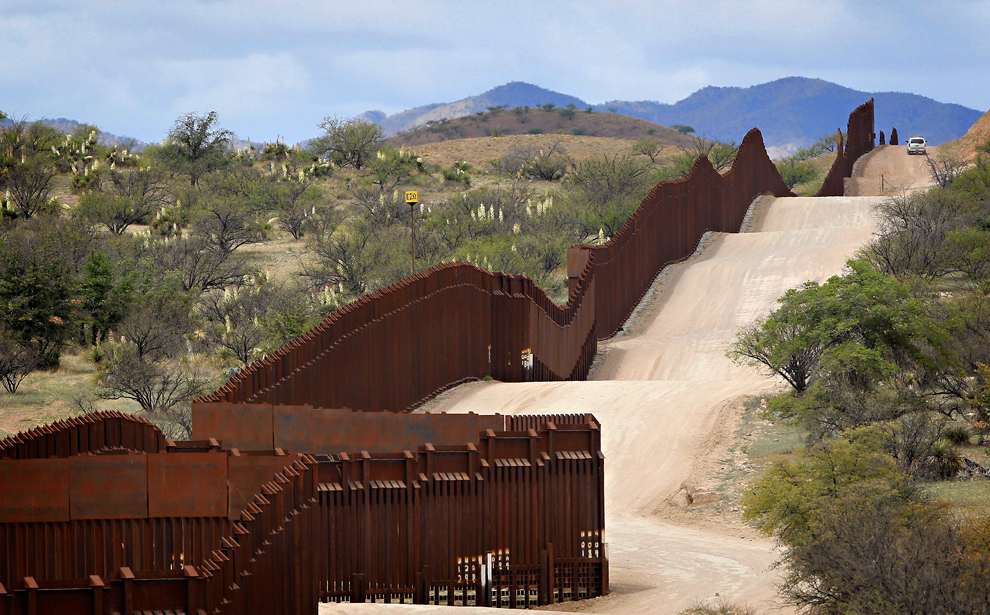 And, believe it or not, President Trump campaigned on building a wall along the border that somehow Mexico would pay for. But there is a wall that has been built along the Arizona-Mexico border.
The other big difference between the US and Canada, is that the US has natural growth build into its population because its Hispanic population is having relatively large families. The US can afford to be choosy and start to pick its immigrants based on their skill levels as we have done in Canada for the last fifty-five years.
Like most Canadians, I follow all the challenges immigrants face trying to find a new home. And the stories of immigrants from places like Syria or North Africa emigrating to Europe are even more compelling.
And with every immigrant story, I think of my grandmother and her family hidden under a tarpaulin in a fishing boat escaping from Romania to seek a new life in England.
09-01 Challenges
(blank) » John Bulloch » 10 Canada-US Relations » 09 Immigration »