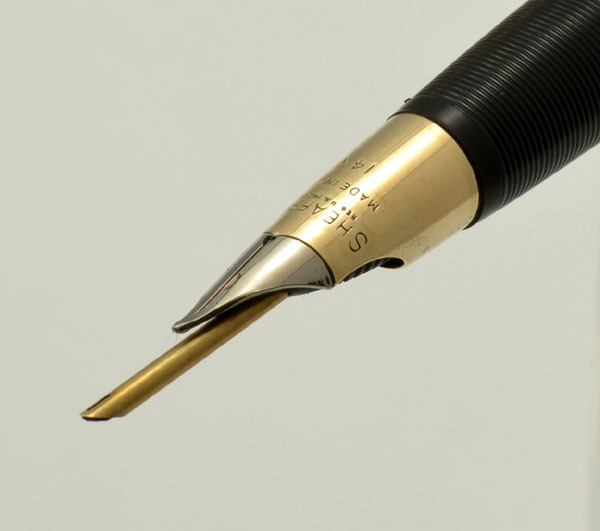
 Do you remember the “Sheaffer” fountain pen where there was a little snorkel tube in the nib for drawing ink? We are talking about high-quality fountain pens before cartridges were invented and the time was 1955. And I am a third-year engineering student.
We were divided into groups of four and had to pick a product to be manufactured in Canada, then work out the manufacturing processes to produce the product, determine the dollars that had to be invested, design a potential plant layout, and figure out the operational costs and a possible plant location. It was a big industrial engineering project.
We decided to manufacture pens because one of the members of our team knew the President of the Canadian arm of the "Sheaffer Pen Company", with a manufacturing plant near Port Elgin on Lake Huron.
“Sheaffer”, like many US subsidiaries in Canada, began with a Canadian sales and service arm and, after domestic sales grew, did some partial manufacturing and assembly. Tariffs were a factor at the time.
Well, we secured a meeting with the President of the company when he was visiting his plant at Port Elgin. And we went through all the relevant issues taking copious notes. It was when we asked him to discuss the factors he had to consider before choosing Port Elgin, he said, “That was easy, this is where I had my cottage.” I remember killing myself with laughter.
It was a much simpler world back in 1955. My early working life had me employed as a lubrication engineer with Imperial Oil and there I learned about the massive investments being made each year to build refineries, chemical plants and pipelines. I soon understood that resources were what we were about as a nation and the reason why so many US dollars head north.
But besides resources, I also discovered during my working life, that we have a lot of other things going for us: quality education at all levels, strong financial institutions and a highly trained workforce. All stuff important to investors.
We live in a relatively cozy culture, but one that does not lend itself to the continuous industrial innovations that societies need to stay competitive globally. The parent companies of the US subsidiaries that dominate our economy provide that function and only partially to our benefit.
Over the years, I have also learned about the many ways Canada works quietly with the US to coordinate regulations, minimize problems for trucks crossing the border, and allow for the movement of labour back and forth. All initiatives that make Canada attractive for investors.
But it does not help the investment climate when we have a relationship between Donald Trump and Justin Trudeau that is bloody ugly, to put it mildly. It is what was hurting investment in the Pierre Trudeau and Richard Nixon years. They could not stand each other either. Nothing is new in politics.
The Canada-US relationship is complex and is forever a work-in-progress.
To give an example. How do you compete as a nation if governments in the US are opening their coal mines and governments in Canada are closing their coal mines? Well, it means the cost of electricity in Canada is much higher than the US.
What was so educational talking with business leaders in places like Denmark, Norway, Sweden and Finland over the years is that they all share similar philosophies. And the same scary winters. So, there are not wide differences in policy. What impressed me was the massive investments being made to deal with climate change and the environment. And yet, nothing they were doing hurt their competitiveness. But think positively. We are going to be global producers of cannabis. That should start dollars moving north. If fortunes were made investing in booze, fortunes will be made investing in “grass”.
And governments will have another “sin” to tax, which is what legalizing cannabis is all about.
06-02 Dollars North
(blank) » John Bulloch » 10 Canada-US Relations » 06 Investment »