An Irish great-grandmother was raised in what was called the Poor House because her father was sent to Debtors Prison when his business when bankrupt.
There was greater sympathy towards debt and bankruptcy during my father’s time because he lived through the depression when suffering and hardship was everywhere. Mother said she always kept some food ready because people that were starving would knock on their door hoping for a hand-out.
My youth after WW2 should be called the good years. A booming economy made it easy to buy a house and take on a mortgage. My first home cost twice my annual salary. And my salary jumped ahead of the cost of housing every year for four decades.
Now it is different with nephews and nieces paying five or six times their income for a home and waiting ten years to get married. And during those ten years there has been little movement in incomes while the price of homes has soared.
So, this is the story of household debt which is at crisis levels in developed societies like Canada. Debt for homes, cars and education. Not for Caribbean holidays.
When it comes to public debt the story is worse. Nations unlike individuals cannot easily declare bankruptcy. Some get to a point when they cannot pay their bills and seek bailouts from the International Monetary Fund. And these special loans come with nasty restrictions. Usually the poor get screwed.
Now if you live in the world of money and banking, there will be all kinds of measurements to tell you when national debts are too high relative to national incomes. Just like when mortgage payments are too high for people’s salaries.
During the 1970s under Canadian Prime Minister Pierre Trudeau, spending was massively higher than taxation.
Pierre Trudeau campaigned on what he called the Just Society which is a left-wing code word for social spending. To pay for it he went into a program of tax reform which was tax increases in disguise.
I left a teaching position to fight the tax package, not realizing at the time that the real purpose of tax reform was to fund a package of generous social programs.
It was the provincial government of Ontario that discovered that federal tax reform was designed to raise $6 billion in new tax revenues. And when we defeated the tax proposals, the Trudeau government still went ahead with its spending agenda.
I asked the Prime Minister why he didn’t propose tax increases up front. Impossible was the explanation. So, the lesson about public debt everywhere is that it is all about politics.
In my opinion, it is about the failure of democracy. We like to say our democratic system is the best system of government but that’s only because every other system is worse.
Europe also has a debt crisis because all the economies use the same currency, which means weak economies have a currency that is too strong. They keep spending to keep their constituents happy but are drowning in debt.
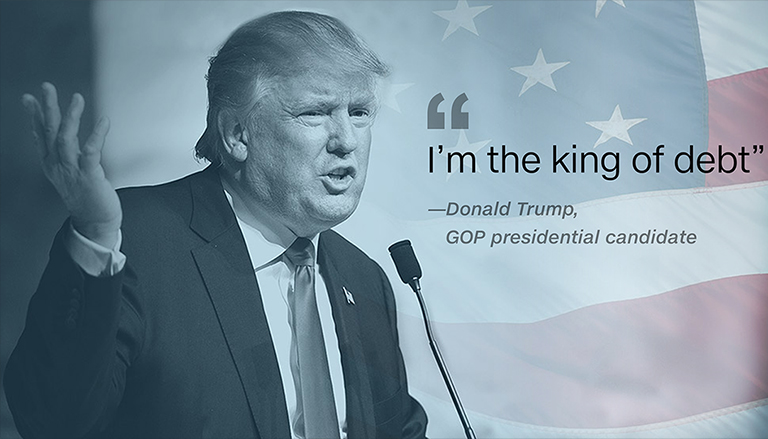
The biggest worry is the US which under Bush, Obama and Trump is heading towards a trillion-dollar deficit and a trillion dollars in annual interest charges. So, in terms of their budget spending it will be interest charges, health care and social security in that order. And raising taxes in the US is like being an atheist at a Baptist convention.
I do not see any way out of this mess except to create inflation, something the US has done in the past. This will make the size of the debt relatively smaller than an inflated economy. Talk about dangerous challenges.
And the rest of the world gets screwed as the value of their money is worth less. But they deserve it, since their debt problems are just as gross.
And what about all those nephews and nieces with the cost of their mortgages jumping by two or three percentage points? Life is not fair.
08-07 Debt
(blank) » John Bulloch » 08 Dangerous Challenges »
By John Bulloch