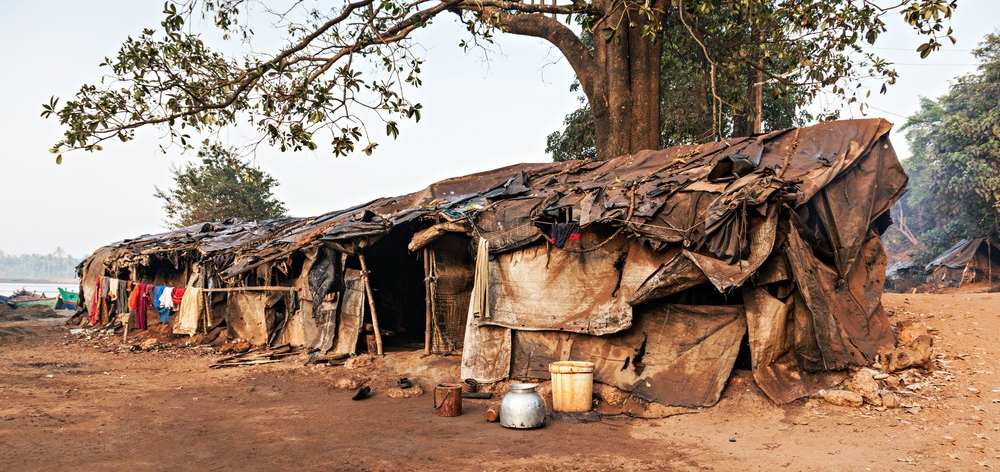
 For as long as I can remember, international aid agencies have been asking us to donate to families of naked black African children with flies on their eyes. Are things any better for these children? Why should you and I care about poverty?
Well it does not look like things are getting better. About ten million children die each year of either malnutrition or bad water.
We can understand poverty to a degree in our own society because we know about income disparities, levels of education and our history. It can be an intelligent debate. Harder to understand poverty in other societies.
My own parents experienced poverty and were married during the depression. And when my mother brought me into the world, one salary made life tough. They could not afford a carriage for me and I slept in the top drawer of the dresser. And on a day before payday, my father had to borrow a dime from a neighbor to get to work and back.
Is this about understanding poverty? Well yes and no. At least my father had a job.
My father worked himself out of hardship by going to night school, mastering his trade, building a client base, saving his pennies, and setting a goal to be his own boss by age 30. His big break was the outbreak of WW2, and a decision to go into the business of making officers’ uniforms. Lots of self-discipline and organization skills at work.
But I did not really understand the enormity of the issue of global poverty until I became active in the International Small Business Congress in 1975, and for 20 years was a participant in the issue of small scale development. And at every Congress we were debating issues of development and poverty.
I quickly learned that one could not separate issues of poverty from issues of population growth. The problem was that the right kind of economic development could never really keep pace with increases in population.
The trouble with discussing these issues at conferences is that it is all so academic. So hard to really understand when people are poor. Spokespersons from the UN would talk about 20% of the world’s population being in poverty because they live on less than $2 per day. Numbers.
Then when taking an evening walk in Manila in 1977, just days before heading off to a conference in Seoul, I was propositioned by a girl of 14, who was the sole breadwinner in a family of four. I bought her a meal. The father was in the hills fighting with a group of communist rebels.
I had a daughter of 14 at the time, and the whole experience was both ugly and emotional. That child prostitute has always been the face of poverty in my life.
But I could appreciate the reality that developed societies cannot ignore nations that are impoverished. The big danger is that these societies do not have the resources to prevent the spread of disease. And today with the way in which economies are integrated, no society is safe.
Remember the Spanish flu pandemic that killed millions in 1919. Well the risk of another pandemic is real because of the close relationship between people and animals in the impoverished nations of the world. New viruses jump from animals to people and then spread globally.
Most of my work associated with poverty in developing nations has been in developing and promoting all forms of small scale enterprise. The key is to allow nations to develop the economic model that reflects their history and culture. How they provide funding, training, technology and market access to encourage enterprise must be of their own making.
I love the micro-financing model developed in Bangladesh, where banks make small loans to groups of women to fund small scale enterprise. And the group agree to cover the losses of any of its members. Entrepreneurs are encouraged to work together.
It would be my personal call that we will never eliminate poverty. Why? Because all development requires self-discipline and organization skills. And we develop these requirements from a system of education and a culture that promotes a work ethic. And this is something one cannot impose from the outside.
And we are fooling ourselves to think the rich nations are going to share with the poor. We work with the undeveloped nations of the world if it is good business or important for our national security.
Poverty is each nation’s dangerous challenge and not something that is subject to global solutions.
08-06 Poverty
(blank) » John Bulloch » 08 Dangerous Challenges »
By John Bulloch