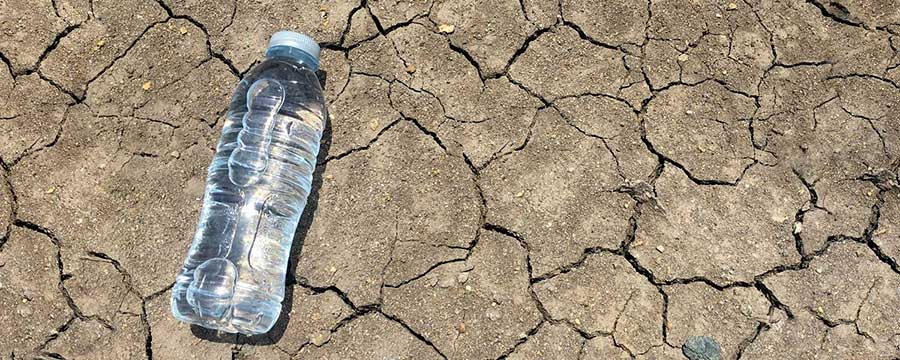
Something like 3.4 million people, mostly children, die each year of water borne diseases. And something like a billion people on this earth do not have access to safe drinking water.
Do people in the more affluent Western societies care? And are their governments driven to do something about it? Well they will as various forms of water related tensions lead to domestic and international conflicts that impact on their security.
Take Syria for example. It is a civil war with many waring factions. But one of the sources of tension has been droughts in Sunni Muslim areas that have driven farmers to live in cities on the coast controlled by Alawite Muslims.
And if you want to look at a part of the world that is becoming dominated by “water conflicts” look to Syria, Turkey, Iraq, Iran, Egypt and Yemen. Water is a big deal.
For example, Ethiopia is building its Grand Ethiopian Renaissance Dam on the Nile River to supply the country with badly needed electrical power. But when its construction is completed it will cut back on the flow of water down the Nile to Egypt, which depends on the Nile for 85% of its fresh water. And Egypt is one of those nations facing water shortages.
Remember all the stories of Egypt during the time of the Pharaohs, when the people worshiped the Nile. Loved my course in Ancient and Medieval History in grade 11.
The Egypt/Ethiopia water issue is an example of the growing number of potential water conflicts evolving around the world. Water diversions in nation A impacts the supply of water for nation B.
And another middle east water crisis is in the making for the Palestinians. I feel sorry for those living in the Gaza strip. Water shortages are going to make that area unliveable. And it may be water that forces an Israel-Palestinian peace agreement.
Governments everywhere have difficult decisions to make. Higher prices for water for their consumers to force conservation is a relatively easy decision. But, of greater importance and difficulty will be new and greater international expenditures for fresh water development. And, hopefully, less reliance on military spending.
Water for peace will be the slogan of the future. The big item, of course, will be investments in desalination technologies and infrastructure.
You just cannot ignore the multiple regions of the world where new fresh water sources have not kept pace with population growth. And it is not just agriculture that draws so much of our fresh water, but water used for power generation and for technologies such as fracking that uncover hidden oil and gas deposits.
And we haven’t even figured in the impacts of climate change that will make all the existing water problems even more severe.
If, for example, mountain snow packs are diminishing as they are in the US, then water sources from rivers and lakes will be reduced. Apparently, there are seven US states as well as Mexico that depend on snow packs from the mountains to replenish the Colorado River.
All the powerful nations like the US, China and India have water challenges. From my trip to China in the mid 1980s I learned that most of the agriculture was in the northern areas of China, but the major sources of water are in the south. Big conflicts between farmers and city dwellers lie ahead over water.
California, which is the bread-basket for North America, is already planning to deal with anticipated water shortages with a major desalination plant installed in San Diego, based on Israel technology.
It does not take a brain surgeon to see the impact of climate change when visiting Alaska, Greenland and the Antarctic. Glaziers melting. Mountains showing green for the first time. Break away ice flows miles long.
And when you see the size of the massive ice-fields in the Antarctic, you can believe that rising temperatures will melt enough ice and snow to raise ocean levels and make low lying regions of the world uninhabitable. Places where people cannot feed themselves because their fields are covered by salt water.
I had not even heard the words climate change or water conflict back in the 1970s when I visited Bangkok and had to take off my shoes and socks and roll up my trousers to cross the street. A city that is only 1.5 metres above sea level. But it gave me a scary feeling. A sense that something was not right.
Any student of history knows that great civilizations fell over the shortage of water. I am thinking of the Tang dynasty in China, the Mayan civilization in Mexico, and the destruction of Ancient Greece.
And one of the most blessed nations on earth with its unlimited supply of fresh water is Canada. But that will provide future governments with some nasty if not dangerous challenges.
Just how many million immigrants of colour will they admit as refugees who are either drowning in salt water or dying of thirst.
08-04 Water
(blank) » John Bulloch » 08 Dangerous Challenges »
By John Bulloch