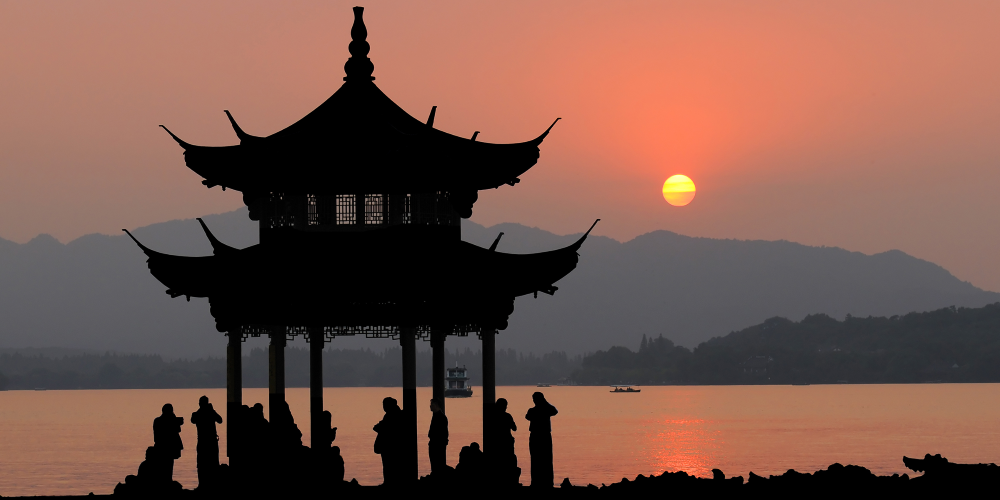
The bold headlines in both the Chinese and English newspapers in Beijing, in October 1985, were four inches deep. “Factories Must Sell Their Production.” It signalled a move by the Communist government that they wanted China to become a more market-oriented economy.
We had just come from Shanghai and visited a factory where young girls were hand-weaving the most beautiful rugs. One girl was working with a colour that seemed a little weird, even for someone such as myself (being colour blind). Her production for the last five years was piled 20 feet high along the wall. No worry. Someone somewhere had the job of selling what she produced.
It was of real interest to me when China joined the World Trade Organization (WTO) in 2001, which is a rules-based membership body that tries to control world trade. It was the final step to becoming a market-based trading economy.
Now before I go off on a tangent, I should make it clear that I loved my visit to China. Of the forty plus nations I have visited, nothing compares to the excitement, the history, the culture, the scenery and the people of China.
It was visiting the Forbidden City and the Great Wall in Beijing, the Bund or cultural section of Shanghai, the Terracotta Warriors in Xi’an. Then there was the cruise down the Yangtze. And seeing where all the illegal ivory ended up in Guangzhou was really something. One amazing experience after another.
And everywhere young people would come up to us and ask if they could practice their English. And they spoke without an accent of any kind. Some serious long-term planning was underway back then with the leadership of China developing young people who would take China into the global economy.
Well, the move of China into the global economy has been a major disruptor. In a way, I would say their economic growth since 2001, is more about displacement than disruption because of their low-cost labour. The Chinese economy during this period has grown by a factor of eight.
But it is because they are not playing by the rules that they have become such a disruptor. A nation that now has a $1.9 trillion annual trade surplus with the rest of the world.
Their sins are many. Firstly, they do not treat foreign firms investing in China as fairly as their domestic firms, which is a primary WTO rule. They in fact, force foreign firms to hand over their technology to Chinese firms using a dozen cute schemes.
They keep their currency artificially low, subsidize domestic firms, and have a master plan to be dominant in every area from renewable energy to micro technology. This makes them a real disruptor.
And to further jiggle the rules favouring exports over imports, they impose a wide range of tariffs and non-tariff barriers.
Of course, we are not dealing with a market economy, but instead a quasi totalitarian state with a long-term plan to replace the US as the dominant world power.
I can remember both Japan and South Korea with restrictive policies in place while they were developing their economies. But nothing to compare with the “Make China Great Again” policies of the current Chinese administration, all dressed up in their fake market-oriented clothing.
And it seems in every market, from currency to commodities, China is there building, speculating, borrowing, and spending. China is more than a disruptor. They are creating widespread chaos everywhere and damaging other societies in their wake. They are central planning gone amok.
Where this is taking the rest of the developed world is a question. Certainly, nations like the US are now sorry they invited China into the WTO. But, in the meantime, they can impose dumping duties on Chinese imports. And, of course, a trade war is a possibility.
If Trump has his way, he will withdraw the US from the WTO, and make bi-lateral agreements with key trading partners. Not sure he can sell that idea to Congress, who are funded, for the most part, by vested interests.
Personally, I do not agree with Trump’s protectionist, nationalist agenda.
A better policy would be to try to just focus his tweets on China and expand and encourage trade with Mexico. The US needs a source of cheap labour to produce standardized products and components to keep its companies and its economy competitive.
And let’s be honest and skip the political BS. America does not need jobs. Its major problem is a shortage of labour.
07-09 China
(blank) » John Bulloch » 07 Disruptors »
By John Bulloch