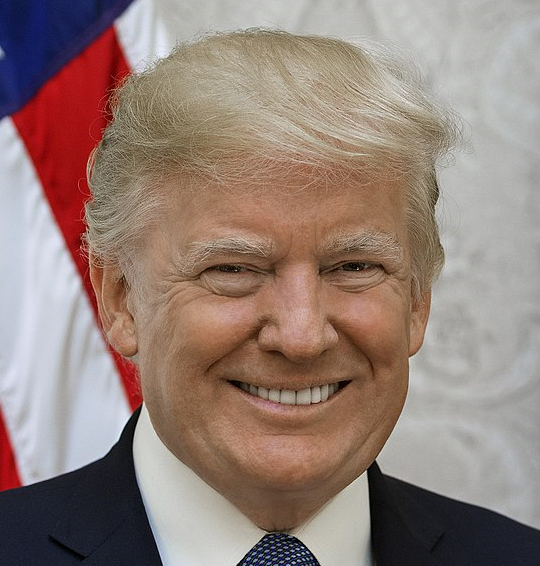
If President Trump isn’t careful he’s going to lose the evangelical vote. He needs professional advice. Something like this. Tell the evangelicals that you were just taking Stormy Daniels to the Lord. Because each time you had sex with her she said, “Oh my God. Oh my God.”
Because I spent 25 years of my life as a small business advocate I became a quasi-politician. So, it is not surprising to be continuously asked what I think of Donald Trump.
Well, my first impression of Trump when he decided to run for President was that he was refreshing because he created the perception that he would be the same person in private as in pubic. Not the slick kind of actor so common in politics.
But as his campaign progressed it was hard to decide how many voters really liked his package or could not stand the thought of putting the Clintons back in the White House.
A former Prime Minister of Canada had similar qualities, and his name was Jean Chretien, a young lawyer that came to Ottawa without any English. He was the same person in private as in public and came across as sincere and concerned about the little guy. But Chretien did not become Prime Minister before holding three major portfolios. So, he really knew what he was doing.
Twice in my former life I have testified before Congress on pending trade agreements. Tough questions from people who were technically informed.
Those hearings were about 60% policy and 40% politics. And this is the key issue. Good politicians are good at both politics and policy. They know how to blend the two skills. I call it the “P&P” issue.
To be good at “P&P”, I took television training in Boston by the same company that trained John F Kennedy. “Show anger, show surprise, show concern.”
But I also had to spend two hours each day reading complex briefing papers. My advisors made me look intelligent.
Everything in the world of public policy is complex. If the issue isn’t about the legal implications it is about politics. And everyone in politics learns on the job.
President Trump will not be successful unless he learns to be both a political and a policy animal. A leader who lacks policy strength will always find it difficult to sell his message to more than his political base.
Political leaders around the world have a third of the population that loves them and another third that hates their guts. But you win political battles at all levels by winning the swing vote. And knowing policy you can manage your message for all the different audiences. Sounds simple but it is difficult.
Tax reform provides lessons. It is almost incomprehensible to read and understand. Yet politicians must sell it to large and small business, to consumers, to women, to youth, to farmers, to professionals and so on. Trump’s tax reform package is a solid piece of work, but he is not selling it.
And here is the more serious matter. If you lack policy smarts, you never really know when you are being played. And being played is part of the job description of politicians. And you can be played as much by your own public servants as by your enemies.
Here is another example of where President Trump has gone off the rails. He is doing what is right for the US in promoting a skills-based immigration policy. Skill shortages is the major challenge facing business in Canada and the US.
But the US debate has been buried in the political perception of an administration that is really interested in restricting Muslims and Hispanics. A clumsy blend of politics and policy.
If Trump is a disruptor it will be because he has successfully taken over the Republican Party, who traditionally have been conservative on spending and believers in free trade. And he is certainly a disrupter in his use of Twitter to reach mass audiences.
And we will certainly take him seriously as a disrupter if he can keep control of both the House and the Senate during his time in office.
Here is another example of why political leaders need P&P smarts: Trump has promised jobs for workers living in areas hit by trade agreements. It was smart politics. Offering hope to people hurting is leadership.
But that is not the long-term threat to the US. The real threat facing the US and the west is shortages of labour generally caused by the aging population.
Protectionism is not a smart economic option. It makes the economy less productive. Massive retraining is smart but that costs money and creates higher taxes.
Trump’s right-wing movement is selling economic nationalism and protectionism as the alternative to globalism.
On the other hand, Bernie Sanders of the left is selling massive spending on training and education to deal with globalism. This is what they do in Europe. But he does not tell you about their 25% value-added sales tax to pay for it all.
Phoney baloney from both ends of the US political spectrum.
Yes, there is lots of manipulation in politics. And the problem with social media is that it makes manipulating public opinion cheaper and faster than conventional media.
In the 1970s I made a friendship with the Governor of the Island of Mindanao in the Philippines. His success was his singing voice. He went from village to village singing to the people and, of course, his voice was better than that of his opponent. Hard to explain what you want to do when your people cannot read or write.
Trump is really selling the replacement of multi-lateral trade agreements with bi-lateral trade agreements. And few people understand the complexity of this issue.
From a policy perspective it might be good for the US but not for the world. The result would be to turn global economic power and influence over to China.
And it is hard to get tough on China when they are your nation’s bankers. They happen to hold over a trillion dollars of US debt. Trump is just doing what Obama did before him. Run deficits and borrow the money from China. As Trump would say in his tweets – SAD.
07-01 President Trump
(blank) » John Bulloch » 07 Disruptors »
By John Bulloch