It was 1983 and I received a delegation from Finland who had flown all the way to Canada to visit with me at the head office of the Canadian Federation of Independent Business in Toronto.
They said they were the leadership of an organizing committee that wanted to bring the International Small Business Congress (ISBC) to Helsinki, Finland in 1987. I was a key member of the ISBC Executive Committee at that time.
The first thing I noticed was the excellent level of their English. And they said they all spoke four languages: Finnish, Swedish, English and German.
With good humour they explained that they are all educated through primary and secondary school in Finnish and Swedish but that neither are international languages. So if you are proceeding with your education towards university you must learn to speak both English and German.
Amongst the team that visited me where two senior officials of what is called today the Federation of Finnish Enterprises, which was ranked with the organization I founded, the CFIB, as one of the largest of its kind relative to the population.
Another official was a professor from a local university and another was a junior member of the government. Impressive.
Everything about the Finns, was of special interest. They were just good at everything they did, in a quiet and very practical manner. A friendship developed that lasted over 25 years.
The big shock I had talking about education with the organizing committee was that it was free in Finland no matter how long you studied. There were no private schools, and all teachers in the public system had to receive a Masters degree in education.
When they talked about the right to an education they also meant an education that is equal in quality no matter where you lived and no matter who you are.
Of special interest, they did not believe in the US system in which public schools compete with private schools for funding and teachers.
I had come to a similar conclusions as the Finns on a number of issues during my years as a teacher at the Ryerson Polytechnic Institute, now Ryerson University. The most important element in education is the quality of teachers. The second element is class size.
Sounds like the punch line of all left-wing teacher’s unions, but they are right. And Finland has it right as well.
When they talk about the right to an education in Finland it means that it is not only free, but compulsory for all children between the ages of six to seventeen.
I asked one of the colleagues in the organizing committee how he lived with the high VAT taxes in Finland that help fund their education system.
He said that their tax system is competitive with that of all the other Nordic countries, like Sweden, Norway and Denmark. So, taxes are not the real issue. You get used to the tax system like everything else in life.
For him, getting free education for his three children that went to university made it all seem like a bargain.
I asked whether it was easier politically to sell equal and free education in a country that was so homogenized compared to say Canada and the US.
Only 5% of the Finnish population is not born in Finland compared to about 13% in Canada and the US. We think of ourselves as more heterogeneous societies.
But what the Finns said was interesting. He said in most of the city schools in Helsinki that absorbs the foreign-born population they have no problem selling their concept of equality in education. It is just part of the Finnish culture to believe in education.
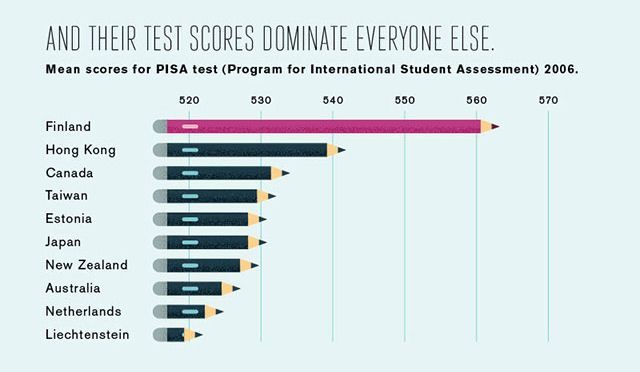
And I did not realize until 2006, when I read a report of the international ranking of the education systems of the developed societies of the world just what an education power house Finland was.
There was Finland in the top spot in the ranking. And how about Canada ranking number three. Anyways every year these rankings were done, Finland was a top contender.
It is so hard to believe that globally there are about 100 million kids that are out of school.
But the solutions for societies are not simple or easy. It is about governance, public commitment, taxation and priorities.
Finland has got it right and so does Canada. And by the way, the International Small Business Congress held in Helsinki in 1987 was a “smash”.
Yes, I believe in “edumacation.”