It was at the historic first International Symposium on Small Business held in Tokyo, Japan in 1975, that I had my eye opened to the complexities of advocacy organizations representing small business. Of the 600 delegates from over 50 nations, 200 were representatives from advocacy organizations.
I made an immediate friendship with those who spoke English, and this included representatives from Holland, Sweden, Finland, Germany, France, Japan, Korea and Taiwan. Up until then, my learning experience had been with my colleagues in the US at the National Federation of Independent Business. Both NFIB and CFIB were advocacy organizations functioning in a federal state. This meant being active in both national and provincial or state issues. For those organizations representing unitary states, their areas of activity were municipal and national affairs.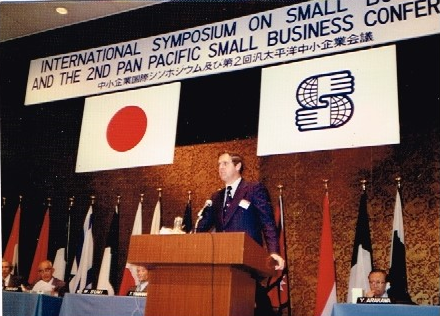 In the photo, I can be seen as the Chairman of a session on advocacy organizations in Europe, North America and Asia. It became obvious to me that advocacy organizations that do not have to raise their own revenues, and members pay fees as a sort of tax, serve fundamentally as an instrument for implementing government policy. These advocacy organizations served as government advocates, not small business advocates.
At the end of the first day of sessions, I had a drink with the president of the Swedish small business organization and we were soon talking business, comparing our two operations. CFIB was closing in on a membership base of 25,000, and the Swedes had a membership of 15,000 paid members and 10,000 Associate members, who paid a nominal fee but did not enjoy any of their special value-added member services. The Swedes used a sales operation for new business sales but renewed members by invoice.
The Associate members represented group or association sales and served as warmed up leads for their sales personnel, who tried to convert them to full paid members. Associate sales were large membership sales. Let’s say 2000 association members at $2 per member provides a cheque from the trade association of roughly $4000. But the problem with their system, he explained, was that the big associations providing the most Associate members used their clout to influence their legislative agenda.
I asked them about their cost of field operations, and to my surprise, their costs were roughly the same as ours, which was 50% of sales revenues. My jaw dropped because it made no sense that an organization that renews by invoice would have the same costs as our organization that renewed by personal calls. The missing piece in this puzzle was the high cost of the value-added benefits that were designed to make it difficult for members to quit. One of their value-added benefits was free travel agency services. Their benefit package was designed to avoid members paying the value-added tax which was about 25%.
The first lesson was learning that renewing by invoice is not a viable strategy without elaborate and expensive member benefits. And the related lesson is that it is difficult to provide leadership in an organization when its membership is united by the availability of cheap commercial services rather than the need to oppose or support changes in public policy.