“John Bulloch? Preston Manning calling.” And what followed was a visit from Alberta in 1986 to the CFIB home office in Toronto.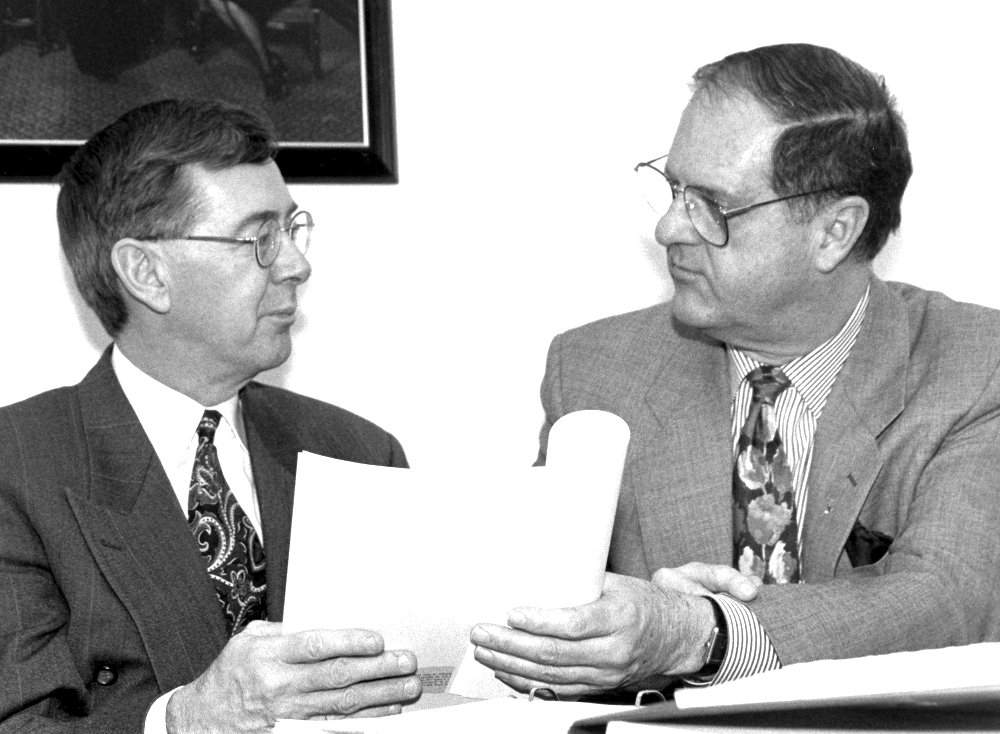 Preston came to tell me that he was going to form a social conservative party and wanted me to lead it. He showed me multiple graphs from numerous studies he had commissioned that demonstrated I had the overwhelming support of non-aligned voters if an election were held at that time. In the photo with Preston Manning taken a decade later, he is the leader of his new Reform Party and a member of Parliament with 51 elected members.
It was not a surprise that he had assumed that my father and I were the same person. My father, from his religious comments in his Globe and Mail advertisements, indeed projected himself as a social conservative.
Senator Keith Davey, Prime Minister Trudeau's party organizer, had made the same mistake two years earlier when he invited me to become a Liberal candidate. He said the Liberal Party is a "big tent party" that has room for social conservatives.
I had to explain to both Keith Davey and Preston Manning that I was not a social conservative. Even more than that, the membership of CFIB was a cross-section of Canadians and on social policy issues, voted like the majority of the population.
But it did not take long for me to see the political dynamics behind Preston's new party, and that was grassroots Western opposition to a moderate Progressive Conservative Leader like Brian Mulroney.
I had a taste of that kind of tension within CFIB in its early days because the original supporters of the Canadian Council for Fair Taxation were the angriest and most extreme in their politics. Only the most enraged voters show up at rallies. And when we built our base by calling on members up and down main street Canada, the membership became more like the general population.
I will never forget an angry Council supporter calling me to cancel his CFIB membership because of the moderate nature of a membership vote. “60-40”, he shouted. “It should have been 90-10”.
If the membership of an advocacy group does not reflect the same general positions as the general population on social policy, then in general, they are not a cross-section of the small business community. Naturally, they will tend to be more conservative on economic issues. There was a time in Germany when each political party had a small business association affiliate. Then a social democratic government put them all under one umbrella by making membership in a new organization compulsory. They wanted to work with an organization that accurately reflected the broader society.