It was called the Royal Commission on the Economic Union and Development Prospects for Canada. And the CFIB report was called A Full Employment Future.
I don't think I have ever been prouder of CFIB than when we submitted it in on December 1, 1983. Our suggestions for the creation of full employment was based on our own research that showed that between 1975 and 1980, small firms with less than 50 employees produced 71% of the country's new jobs, but when taking the period 1975 to1982, firms with less than 50 employees created all the new jobs.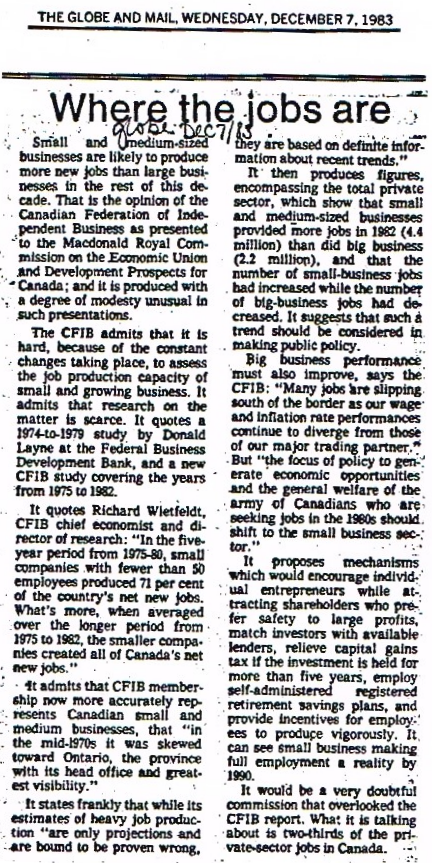 Media pick-up was national and widespread; but the most prestigious coverage came from the Globe and Mail in the form of a lead editorial. We were the only organization that submitted briefs to receive this honour.
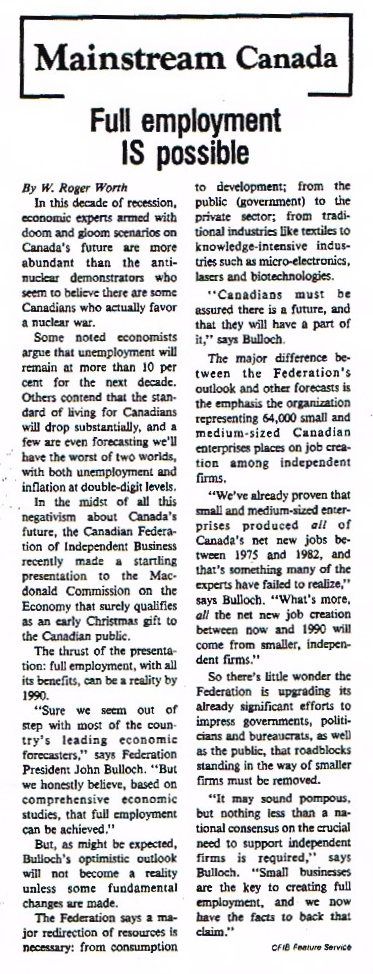 And of course we put the substance of our recommendations for policies to support entrepreneurship and new venture formation in our weekly column called Mainstream Canada which at that time, was being picked up by over 500 weekly newspapers across Canada.
I remember how hard it was in 1971 and 1972 when we were trying to get our field operation functioning correctly to ensure that at each new business sale and renewal sale, the District Manager got accurate data on our members, especially the number of their employees. It was this database that made our submission to the Royal Commission so powerful.
But credit is also due to Pat Johnston, our VP Legislative Affairs, who quarterbacked the project and did most of the final writing. Pat left CFIB at the end of 1983 to get married and live in Montreal. She went back to university to get a PhD in Business Policy and then spent the rest of her professional life as a researcher and teacher under her maiden name Pat Pitcher. Pat died in 2015 at age 64.
CFIB’s quality submission was read by everyone at the political and bureaucratic level across Canada and resulted in multiple legislative victories that enabled small firms to continue dominating job creation.
Collecting membership data was a crucial part of the founding of CFIB. At the National Federation of Independent Business, who had a similar field operation as ourselves, they never made this a priority and in the 1980s, they could not tell you whether their members were male or female. When they wanted to do research, they would buy a database from Dunn and Bradstreet. The huge lesson for CFIB is not just having a database, but having the field as the key to providing that database. The reason for the high morale at CFIB then and today, was that everyone makes a difference.