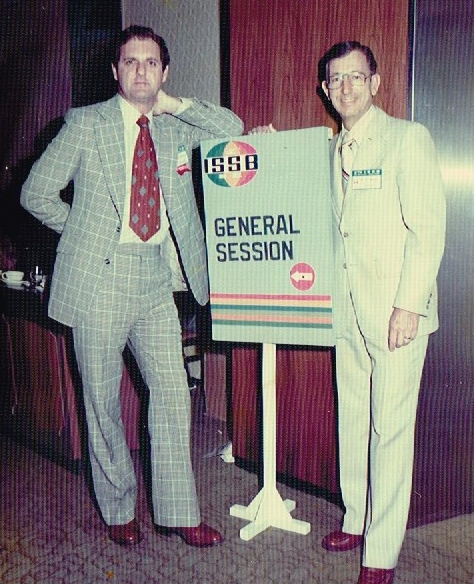
 It is scary and exciting to witness powerful forces of change. I saw for the first time a vision of what we now call the global economy in 1977 as part of my trip to the International Symposium on Small Business held in Seoul, South Korea. The Symposium was a gathering of world leaders associated with entrepreneurship and small-scale development.
It started with an advance trip to Manila in the Philippines, where the Canadian Trade Commissioner lined up meetings with government officials and business leaders.
I was shocked to find soldiers with machine guns at all the doors of the hotel. And going for a walk near the hotel, we were propositioned by a young girl of only 14.
The trade commissioner took me to an industrial park where over 200 subsidiaries of large US companies were under construction. At 3:00 pm, everything came to a halt when the schools emptied out and as far as the eye could see were children in blue uniforms.
At the conference in Seoul, the theme was the threat to western society caused by the explosion of educated young people in 3rd world countries who would be entering the workforce over the next 20 years. The agreement, in general, was that if western society does not help create employment for these young people, their societies would go Communist.
This message hit home because of what I had just seen in Manila with the armies of school children, and I had also bought a meal for a child prostitute who said her father was off fighting on behalf of a Communist insurgency.
The keynote speaker at the Congress said that production sharing was 10 per cent of world trade, but that this phenomenon is anticipated to grow to 50 per cent in ten years. So what I had seen in the Philippines were US companies who were setting up subsidiaries there, that would assemble products from parts made in the US and elsewhere and then sell those products from the Philippines into the South Asian market. 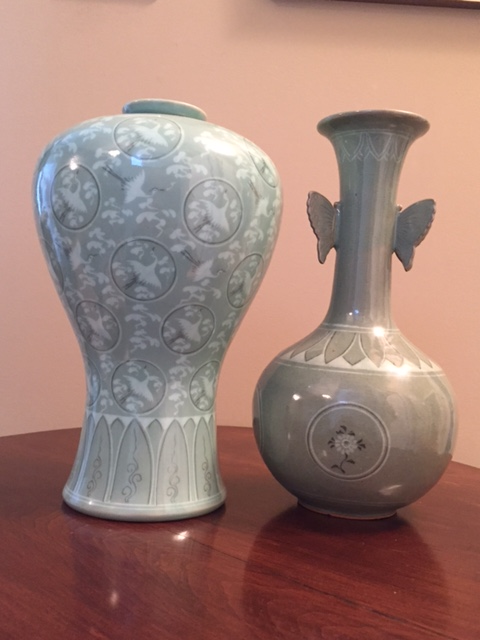 A huge surprise in Seoul was seeing hundreds of construction cranes dotting the skyline. It was a city struggling to be part of a new world that was just on the horizon. Seeing butcher shops on the main street with dog carcasses skinned and hanging from hooks was a shock for any westerner. Then stores selling the famous Celadon green pottery which was part of their craft history was a special delight. We bought two treasures for our home shown in the photo.
Something unusual was happening to the way the world economy functions and I felt I was one of the few who could see what it all meant. No one used the term "globalism" in those days.
The global economy which today has killed so many blue-collar jobs in developed societies, has raised the standard of living of hundreds of millions of people in the developing economies of the world. And all those colourful Asian cities of the 1970s now all look alike with the same towers and shopping malls you find in major North American cities. And my beautiful Celadon pottery can now be bought online or at a local department store.