If I learned anything during my first ten years building the Canadian Federation of Independent Business, it is that nothing works quite like people assume things work. Does a Minister run his government department? Not necessarily. His Deputy Minister reports to him, but also to the Clerk of the Privy Council, the top bureaucrat, who in turn reports to the Prime Minister. So sometimes it is the Prime Minister that is running a Department in terms of policy direction.
During the 1970’s the scuttlebutt was that the Prime Minister was determining economic policy and not the Ministers of Finance, which made for a lot of tension within Cabinet.
And it was the same kind of problem at the provincial level. A premier would appoint someone to Cabinet, not because they were competent, but because they represented an important region of the Province. So the Premier would run his department through his Deputy Minister.
One of the reasons the Prime Minister's Office in Ottawa is so large and powerful is that the people in the PMO are actively involved in the operations of all the various departments, sometimes even screening the speeches of Ministers.
So when we learned how to lobby in Ottawa, we had to spend equal time in the Prime Minister’s Office and all the various departments. A brief sent to a Minister was always copied to the Prime Minister.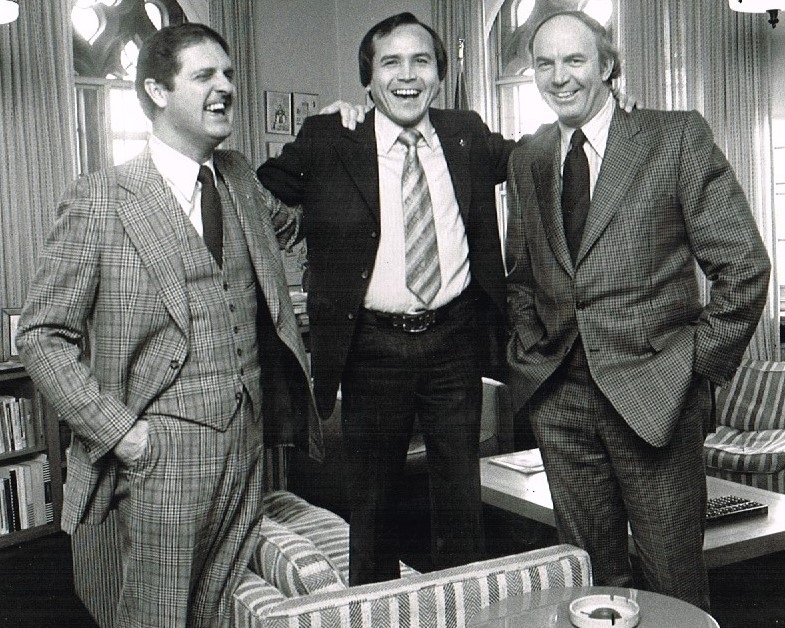 We had excellent relations with all the Ministers of Finance in the early days; John Turner, Donald MacDonald and Jean Chretien. From the photo, you can see the fun we're having at a 1976 meeting with Len Marchand, Minister for Small Business, and the Minister of Finance, Donald MacDonald. We lifted Len Marchand up onto the sofa.
An important victory in the MacDonald budget was that the small business corporate tax rate would apply to $150,000 of business income up to a lifetime limit of $750,000. The former numbers were $100,000 and $500,000.
Another victory that gained support from Jean Chretien and the PMO was a $100 million tax credit for small firms for hiring new employees that would offset the massive payroll taxes employers had to pay. Under the Trudeau government, there had been five increases in UI benefits that were such a disincentive to work that they were a cause of unemployment.
Another area where appearances are deceiving is at the provincial level where the public assumes bureaucrats are working for the Ministry of the Environment in say, BC, develop policy in BC. This is not necessarily true, because the real expert may be working for the Ontario or Quebec government. And the same situation can exist if the top labour expert in Canada is working for the BC government and is helping all the provinces. The networks of directors across Canada who are the authorities all work as a team. At the federal level, dealing with complex matters such as taxation, governments often bring in private sector experts to develop legislation.
Politics is about perception and emotion. No matter how we might want to transform how we elect governments, the reality is that the complex issue of governing will always result in power being exercised by those with knowledge and credibility. Nothing is ever the way it appears.