There are a couple of memories that help understand Haiti, possibly the most impoverished nation in the western hemisphere.
The first is a cruise stop and taxi-ride in the 1980s. The cab driver spoke English which he learned in an American missionary school. I told him that I thought everyone spoke French. He said his half-brother spoke French which he learned at school. But at home they all speak Creole. It was the only language his mother spoke. His mother knitted jerseys that were shipped to America. The other memory is of Canada’s Governor General Michelle Jean, from 2005 to 2010. She was Haitian and lived in Montreal which has a large French-speaking Haitian population. I remember Madame Jean in tears on national television when an earthquake hit Haiti in 2010.
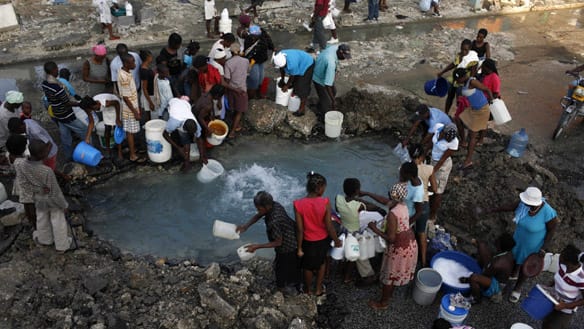 The earthquake is important in understanding the water crisis in Haiti today. The photo shows what used to be a functioning well that was destroyed during the earthquake.
Even today there are a number of foundations and aid organizations rebuilding infrastructure destroyed in 2010.
Nevertheless, only about half of the population today has access to clean drinking water. It is a pattern found in impoverished nations. Drought in some areas. Flooding in other areas. And a lack of proper infrastructure to treat both water and sewage.
Haiti is part of an island area shared with the Dominican Republic. The capital city that draws the tourists is Port au Prince. 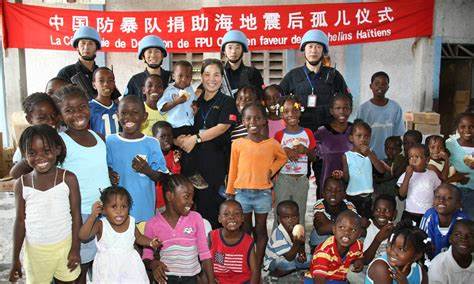 The big story is China offering to invest $30 billion on the Island. They are promising investments in sanitation facilities, power plants, water treatment systems, railways and low income housing. The headlines call it “China extends its silk road to Haiti.”
I have seen this process already in place in Grenada. Of course, part of the package is Grenada cutting ties with Taiwan. This is the long-term goal for Haiti.
These investments start as grant money, then soft loans, then political demands. And, if nations like Haiti do not pay for their loans, China will own strategic infrastructure in America’s back yard.
But the poor folk living in Haiti are more interested in clean drinking water than politics.
02-11 Haiti
(blank) » John Bulloch » 27 Quirky Water » 02 Nations »
Haiti’s tragedy is more than poverty, but an earthquake in 2010 that destroyed much of its water infrastructure. And, surprise, surprise, it is China offering to provide the capital to rebuild the nation. Another future Chinese satellite in America’s back yard.