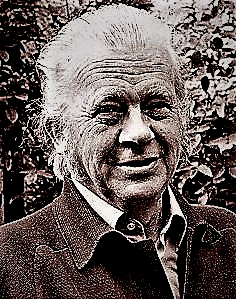
 Dr. Schumacher, I’m John Bulloch. “Yes, come in John. And call me Fritz.” It was the summer of 1976, and I was about an hour away from London visiting E. F. Schumacher, the author of Small is Beautiful, the hot publication railing against bigness and modern technology.
The first thing he did was declare his belief that development in a community requires people that have both self-discipline and organization skills, but that these qualities are lacking in so many undeveloped societies.
His solution was what he called appropriate technology that used local materials, that is labour intensive, and not dependent on fossil fuels. He proudly showed me a clay, pot-like container he had made that could be made in any village and used to grow herbs and greens that would provide enough nourishment for one person per day.
And then he talked about creating new forms of concrete using local materials that people could use for building their own homes. He was also excited about using bicycles for pumping water.
It was a development model I had problems with because it was not a “learning by doing” model, that builds skills and discipline. The bulk of these technologies were developed by engineers in the developed countries.
The photo above was taken the year of my visit. He died the following year.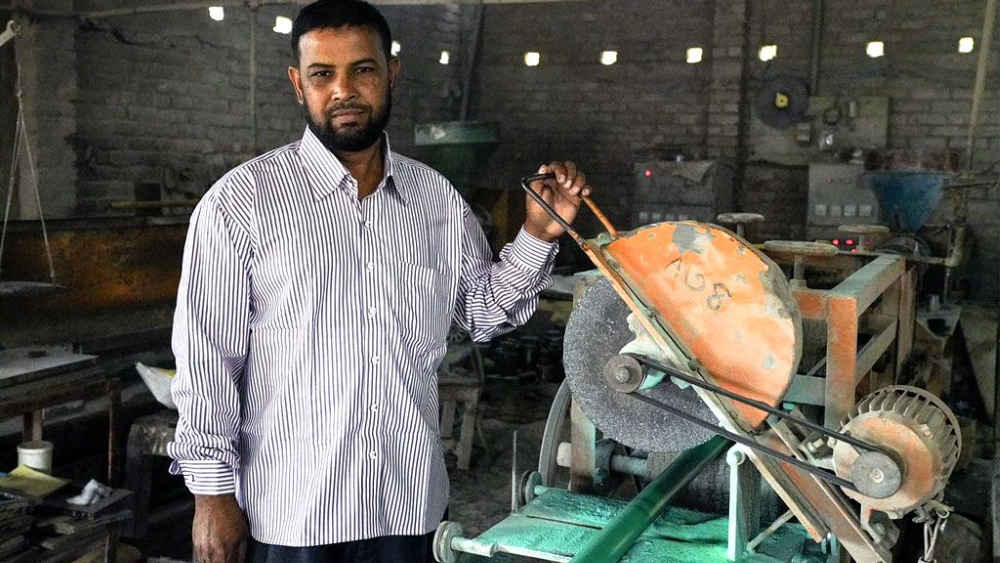 A third world development model that showed more promise was called microfinance and developed in Bangladesh. Here very small loans were made to support self-employment for people who were impoverished. And about a dozen of these recipients jointly agreed to guarantee their loans. The feature of this project was that it was designed to encourage recipients to co-operate together.
At an International Small Business Congress, we were told that about 74 million of these loans had been made. It was a “learning by doing” development model.
Development models that help build strong small and medium sized businesses anywhere were of special interest to me. And I discovered that although countries like Germany, the US and Japan had different ways of supporting enterprise, they were all “learning by doing” exercises.
In Japan, they have laws on subcontracting to encourage local subcontracting by large corporations, rather than outsourcing. I saw examples of major companies providing loans to their subcontractors.
And they encourage small firms to work within their co-operatives or what we call trade associations. I visited a co-operative made up of machine shops, where training and entertainment facilities were jointly financed, and where companies shared machinery and even workers.
Then I visited Germany and saw how a huge sector of their small business community was trade-based. So, before you could start a company you had to earn your master ticket learning not just a skill such as baking, but also how to run a bakery.
The failure rate of these businesses in Germany is about the same as franchises in North America. No wonder they have ten times the number of breweries and bakeries per capita as the US.
And the US model of free entry and exit into a business leads to high levels of failure on the first try but huge levels of success on the second try. It is referred to as the “scar-tissue” development model. And of course, US small firms are active in their trade associations for education and training purposes.
If there is one lesson learned from trying to understand development over the years, it is observing people working and building enterprises in some form of organized, “learning by doing” endeavour. In other words, the economic lone wolf is always a dead wolf.
That’s the way I see it anyways.
02-03 Development Models
(blank) » John Bulloch » 25 Quirky Opinions » 02 Learning by Doing »
Development requires people with self-discipline and organization skills. Often lacking in less developed societies.