 Maria was an alteration tailor that worked for my father for 20 years. I got to know her story during the summer of 1950 when I was an unskilled “jack of all trades” working in the family tailoring business. I was seventeen.
She was from Calabria, Italy and had worked with a needle since she was eleven. She said that she started working first from her home and then, as she became more skilled, as an apprentice at a local factory.
They did not have minimum wages in Italy at that time, and Maria earned just enough to feed herself.
Hard to say whether she was a victim of child labour. Today we refer to abusive child labour as a form of “child slavery”.
Her story was common and about a family in poverty with more children than they could support. At least, her many brothers and sisters had some schooling.
Anyways, by the time she emigrated she was classified as a qualified “tailor” and brought skills that Canada needed.
Her story was better than my grandmother’s story, which was of a young girl of five working in the family upholstery business in Romania, and without any schooling. My grandmother’s story is closer to what we would call “child slavery”.
There is a distinction when forms of child slavery are just unfortunate and when they are pure evil. My grandmother’s story and Maria’s story are unfortunate and of another time.
My research would indicate that today about 150 million children between the ages of 5 and 14 are working full time and without schooling. So, we must have lots of evil in these numbers.
I remember talking with our guide in China about clothing made using child labour. She was honest and said that in the Eastern cities of China where you find most of the clothing factories the workers are all over 16 years of age, but these companies do a lot of subcontracting to factories in rural China that use child labour.
But when we get into the world of evil and children, selling children to pay off debts, selling children into prostitution or as cheap labour top my list of what is truly disgusting. 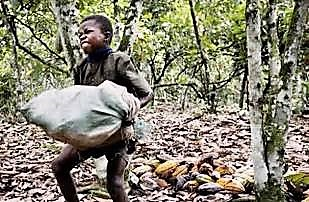 The photo shows a child that has been sold to work in the business of raising cocoa in the subcontinent of Africa, which is what they use to make chocolate. And large numbers of children are also sold to raise cotton.
In a previous chapter I mentioned being propositioned in Manila by a girl of 14. She was not working for a pimp or a madam. I guess you would call it “survival sex” which means procuring for needed food and clothing.
But the same year, which was 1977, when visiting Thailand, I saw evidence of young girls prostituting themselves. Prostitution in general was a major industry with plane loads of men arriving each week for what they called “sex tourism”.
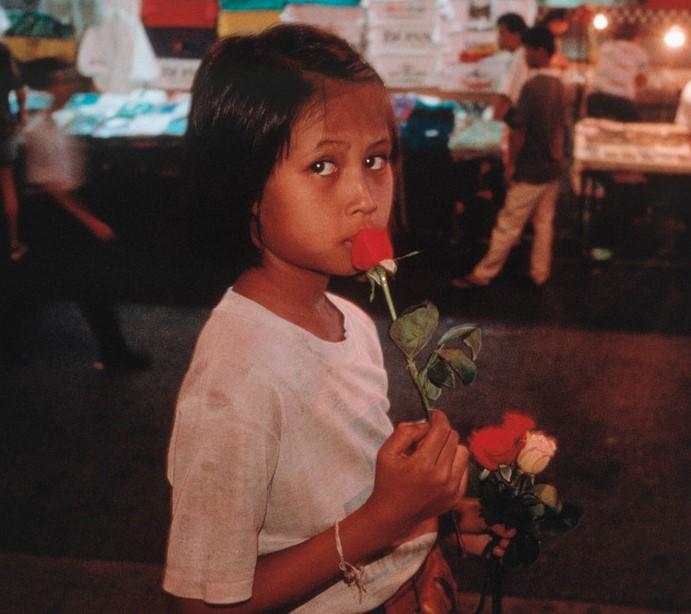
In the top photo we see one of the young Thai prostitutes not unlike those I had seen in the streets of Bangkok. The rose is this girl’s signal.
Child prostitution is upfront in some nations but underground in others.
Even in advanced nations such as Canada or the United States, there is lots of evidence of people seeking young girls and boys for sex. It is a criminal act.
The history of slavery in nations like the United States and Brazil is not pretty. But slaves were valuable property and keeping them healthy and alive was prudent.
But things like child labour and child prostitution are about exploiting people for a short period of time while they can command a good price. Then they are discarded like garbage.
All forms of abuse of children are issues of public conscience. Profiling their horror in the media is a big help because nations that openly exploit children are usually nations plagued with corruption. They must be globally shamed.
Unfortunately, only governments that want to elevate their societies and build for the future will really crack down on the abuse of children.
That’s the way I see it anyways.
16-04 Slavery
(blank) » John Bulloch » 25 Quirky Opinions » 16 Children »
It’s a form of slavery when families send children out to work.