 It was only a week after the September 11, 2001 US terrorism disaster called 9/11 that I attended the International Small Business Congress in Stockholm, Sweden. And a professor of economics got us into the issue of development and income inequality.
The politics were of special interest, because Sweden’s corporate tax system was very competitive, however its personal and consumption taxes were amongst the highest in the world. The politics of Sweden was to reduce both economic and social disparities, and they have been very successful.
But the professor made the point that even Sweden cannot avoid growing income disparities as their economy becomes increasingly global. His point was indisputable, that the combination of global economics and domestic politics is essentially incompatible.
Every nation is facing this problem. For example, in attempting to reduce income disparities by placing heavier taxes on the so-called rich, the rich are able, with the help of sophisticated advisers, to find multiple ways to hide their wealth. Managing funds in tax havens is a billion-dollar industry.
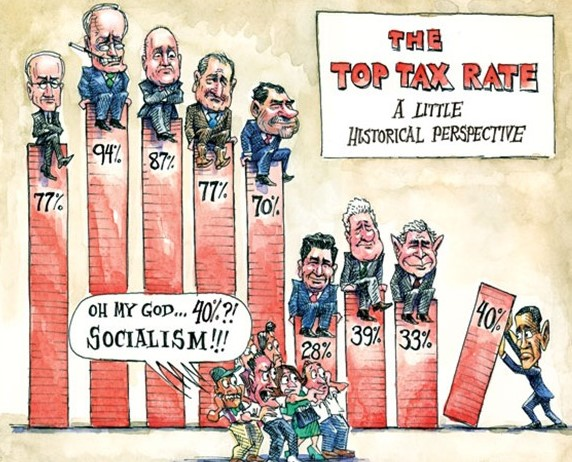
This explains why upper income tax rates in most nations have been reduced over time, as the cartoon suggests. Governments, believe it or not, extract more taxes from the wealthy when they lower upper income tax rates. Why? Because they bring their money home.
Here is a relatively simple way to hide money. If you are constantly travelling to Europe, you carry cash and deposit it in a numbered account. Then the money can be transferred on to a tax haven bank account. All very hush, hush.
And as governments everywhere increase domestic taxes to distribute income, more of their economies operates on an unrecorded cash basis. Even the non-rich understand tax evasion.
So, listening to experts trying to explain income disparities using suspicious government data is both difficult and confusing. But they all agree on one thing. Globalism increases disparities and disparities have political consequences.
As an MBA student in the 1960s we were told that if governments want to increase consumption spending they will reduce taxes on low income citizens and if they want to increase savings they will reduce taxes on the rich.  In terms of increasing savings that policy seemed to be sound economics then, but not today. Because for those who are wealthy, they can find so many new ways to spend money and save less. Better to rent or own a cabin cruiser in Italy or France than LA or Miami. How about a villa in France rather than Key West. Keep that over-consumption secret.
So, when a government reduces taxes on the wealthy it usually has more to do with politics than economics. This is what happens in countries like the US where politics is controlled by money.
And what about the differences in income inequality between nations? This is where international trade and investment deals are supposed to help, and they do.
Few people appreciate the reality that our current international economic system was created to keep developing nations from adopting communism as an ideology. And that the United States was the driver of this new system.
When my great grandparents moved from Austria to Romania and then to England it was to better the lives of their children. And when their children moved to Canada and the US it was to improve the lives of their children.
But now immigration has been politicized and ideologues have a political target to explain unemployment and stagnant wages, despite the reality that immigrants outperform those born locally in every economic category.
If anyone is paying attention to the news from around the world, we can observe that globalism is having powerful political consequences.
One consequence is called “populism” which is a nationalist political agenda that is popular but not workable. It is a form of fake democracy.
Another extreme option is called “plutocracy” in which governments completely surrender to globalization so that democracy is essentially meaningless.
The challenge of politics in a time of increasing internationalism and income inequality is finding the right blend of policies that support both domestic development and global engagement.
That’s the way I see it anyways.
11-04 Political
(blank) » John Bulloch » 25 Quirky Opinions » 11 Income Inequality »
Supporting globalism and reducing income inequality is an impossible political task.