 My father taught me a lot. And he loved to talk about his first year in Canada working on a farm outside Regina to pay for his passage from Ireland. He was 20- years of age and it is 1928.
In those days farms were not mechanized and he was one of four young immigrants helping to bring in the crops and acting as general labourers. There was no central heating and no inside plumbing. “Everyone was poor”, he used to explain, “but nobody felt poor”.
Remembering some of his stories: He helped build a farmer’s barn when it was destroyed by fire. And he remembered using a horse drawn wagon to drive someone to the hospital in Regina. 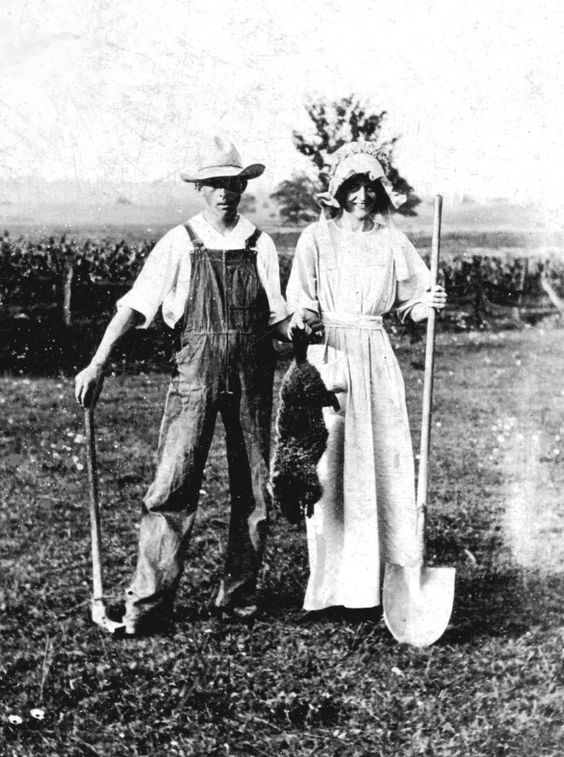 And, each weekend all the farmers and their workers would get together for a social funfest. Everyone would arrive with a basket of food of some kind.
They were grain farmers but the area around the farm house was dedicated to growing vegetables and raising chickens. Dad said he remembered arriving at a party carrying a basket of turnips.
And he said he was pretty good at performing an Irish dance as his share of the evening’s entertainment. The farmers of Saskatchewan were a tight knit group.
So obviously income inequality is not the same thing as poverty. No one was rich or poor in a farm community. The big issue was the climate. In places like Saskatchewan and Scandinavia, everyone helps one another because that was what it took to stay alive in the winter.
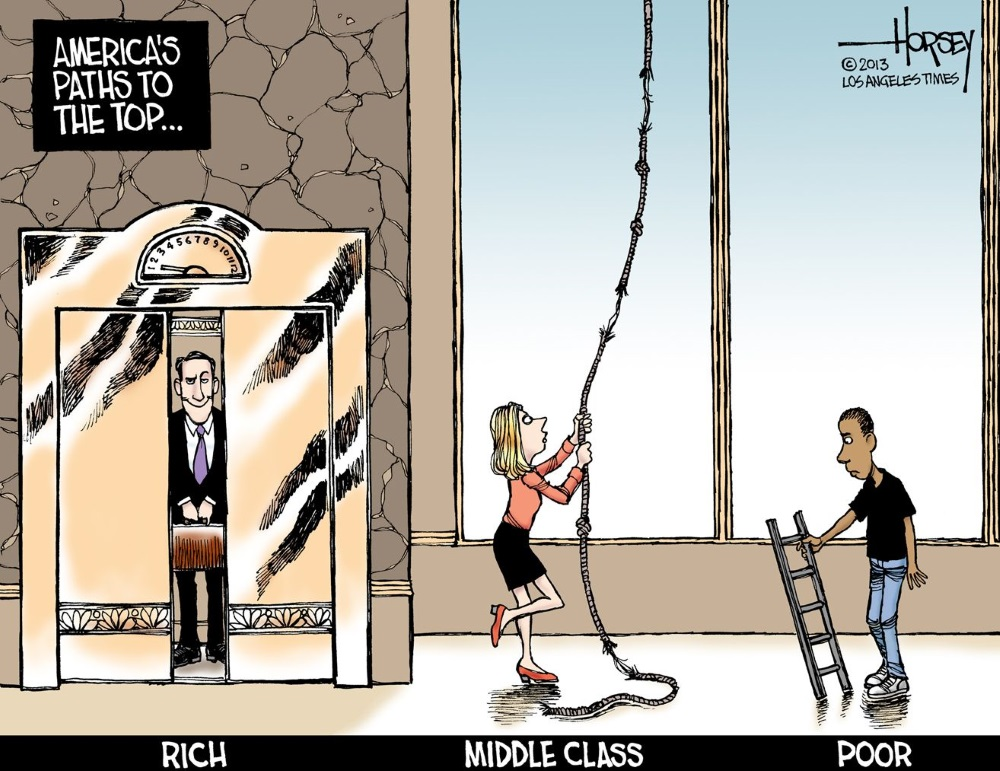
My father always thought that some how he would get ahead and so did the young immigrants he worked with. They were in now in Canada, which represented opportunity. But like the cartoon suggests not everyone can see a path to the so-called top.
It was a very different experience on a cruise in the 1980s sitting at a table with three couples from Birmingham, who thoughts the “blacks” in their area were lazy and looking for handouts.
To my shock and surprise all six carried a gun in the glove compartments of their cars, and they all would put their guns on their laps at a stop light in the downtown area.
One of the group, who was a druggist by trade, said he was held up by a black the previous year. But he was prepared and had a small revolver secreted in his cash register which he used to shoot the intruder in the face.
I asked them how they could live in a place like Birmingham? That was a big mistake, because the following day they had themselves relocated to another table.
For a period of about twenty-five years I attended conferences on small scale development. The authorities everywhere considered the development of small business central to removing the tensions associated with wide-spread income inequality. And, importantly, it was a strategy that could be sold to governments of all political stripes.
And what I took from these debates over the years was that public policy designed to reduce economic inequality is always coupled with the reduction of social instability. And, at international conferences these debates were never a question of left vs. right politics.
It is obviously easier to be a “policy wonk” than a politician.
Over time, I became a convert to the proposition that reducing income disparities stimulates economic growth. This is not a widely held belief. To some, especially in the US, it sounds like communism.
The thinking goes like this. When we have income disparities, we have social disparities. And when we have social disparities we have lower levels of spending on public health, public education and environmental protection.
This kind of thing can be seen clearly in underdeveloped societies. And we are blind if we cannot we see this in developed societies?
That’s the way I see it anyways.
11-03 Social
(blank) » John Bulloch » 25 Quirky Opinions » 11 Income Inequality »
My father worked on a farm in 1928. He said everyone was poor, but no one felt poor.