 My grandfather did not really understand things like the unequal distribution of income in society. He used to say to me with great humour, “I did not get an edumacation.” He sold sandwiches and coffee on the CNR run from Toronto to Winnipeg.
But he was enterprising and after he did his regular chores he was in business for himself selling jewellery and anything the soldiers would buy. I was with him in 1944. He had two hot sellers: ball point pens and “French condoms”.
No surprise that the railways eliminated my grandfather’s job.
Just recently in the small town of Tottenham, close to where I live, a small service station that provided old fashioned service installed modern self-service pumps. Four unskilled jobs were eliminated.
Not hard to see how eliminating unskilled jobs in all the developed economies creates income inequality.
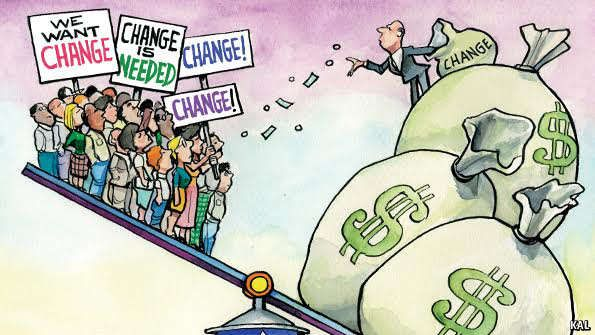
It is hard, however, for the public to see the big picture. The cartoon tells the story. People want change but do not know how to articulate the kind of changes society needs to make.
If you follow the media stories, another common thread is blaming income inequality on the high salaries paid to executives of global companies. This is simplistic.
I know an actual case of a CEO who went from earning $2M per year in Canada to $5M a year in the US managing a global company. But at his US job his income was half, as a percentage of sales, compared to the Canadian job.
And it is not hard for people to understand the importance of education in raising incomes. During my teaching days at the Ryerson University we were given important data on the rising income of graduates over a twenty- year period. There is just no economic payback that compares with education.
So why doesn’t everyone seek a higher education. From my experience it is more than having or not having the intellectual horsepower. It is about young people having the necessary self-discipline and ability to organization themselves. Or the passion to acquire these skills.
About a third of my students were more mature and had come back to school because they had been in dead-end jobs. And none of these students ever failed. They were motivated and focused. Learning is hard work.
Here is another interesting story. Visiting Nassau with my father in the 1970s, he came with gifts for the children of a waitress he had met at the Howard Johnson. She had three children from three different men. We visited her small two room government provided home built of concrete blocks and without glass on the windows. She was hard working and bursting with personality. But she was trapped in poverty.
And Nassau, we learned, was plagued with this kind of social breakdown. . And a few years later I spent a week in the Barbados where the family units were strong, and the degree of poverty greatly reduced in comparison to so many of the other islands. There was a sense of order and discipline in this society that had been imposed by Britain when it was a British colony.
Today, income inequality is not just about uneducated workers dealing with stagnant incomes but educated workers everywhere facing change and dislocation. It seems globalism and technology are replacing a wide range of traditional jobs.
So, the issue of income inequality is not just about jobs disappearing, but about the failure of developed economies to produce workers with the changing skills that companies need. I have met CEOs using Indian programmers and technologists that they can’t find in Canada or the US in sufficient numbers.
It was a shock in 1952 as a first-year engineering student being told that only a third of us would graduate in four years. And that is what happened. Everyone was intelligent, but not everyone was smart. Only a third of us had the discipline and organizational ability to graduate in four years.
And that is why my grandfather did not succumb to poverty. He was an uneducated WW1 veteran, but he was organized and disciplined.
Some societies, some groups and some individuals have it. Adapting to change is just not in the cards for those who don’t.
That’s the way I see it anyways.
11-02 Understanding
(blank) » John Bulloch » 25 Quirky Opinions » 11 Income Inequality »
Eliminating unskilled jobs creates income inequality.