 You probably realize that changing our tax laws is bloody complicated. Well major new trade agreements are just as techy.
So, participating as a representative for small business in both the Canada-United States Free Trade Agreement in 1987 and the North American Free Trade Agreement in 1992 was a major educational experience.
And, with affection, I remember getting a private briefing from Simon Reisman, our chief negotiator of the Canada-US Free Trade Agreement. He was the Deputy Minister of Finance under Finance Minister John Turner when they rewrote the Income Tax Act in 1972. We developed a friendship.
The negotiations associated with the free trade agreement with the US were a big deal, from both an economic and political perspective. NAFTA, on the other hand, was not a momentous agreement, in any way.
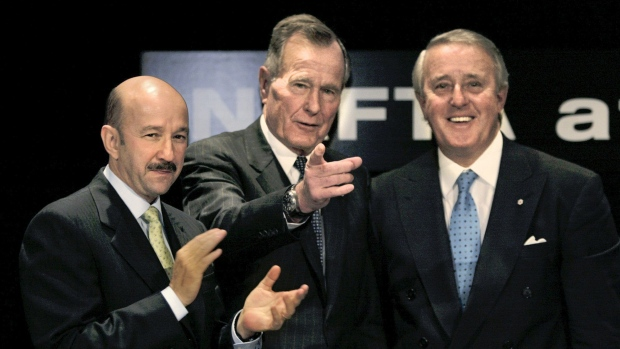
The promoter was President H W Bush in the US who wanted to see the Mexican economy grow as the only real answer to Mexican illegal immigration. He is the real player in the famous photo, above, of what was called the “Three Amigos”. Besides Brian Mulroney and H W Bush, we have President Carlos De Gorton of Mexico.
During both agreements, there were about eight subcommittees who worked with the negotiators on each key section. It was my impression that all the industry representatives were more worried about protecting the gains from the Free Trade Agreement than lusting after better access to the Mexican market.
As per so many of these business-government collaborations you are continuously surprised at the long-term thinking of the big corporate types. I learned about how much the economies of Spain and Portugal had grown after they were part of the European Community, and how the large numbers of educated youth in Mexico meant that it would be a strong growing economy in the future.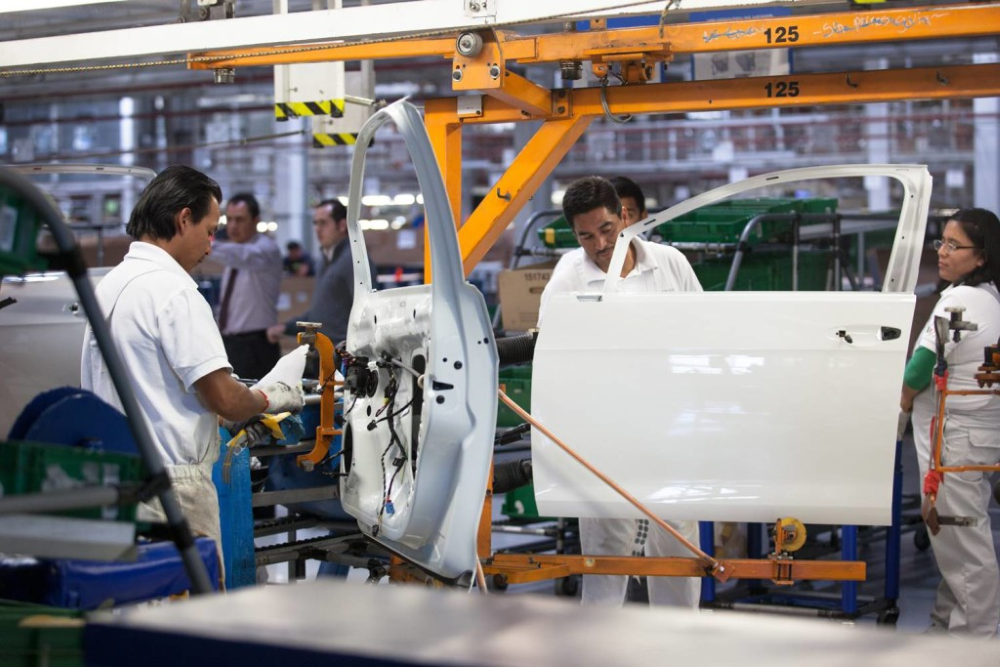 The public debate was about the cheap Mexican labour and the jobs that would be lost. This was not the issue for the business community because any component parts that were of standard design and manufacture, would be produced in China if not in Mexico. But, they all liked the convenience of having production facilities in Mexico.
The most important issue during the NAFTA negotiations was the final design of a Dispute Settlement Provision. Prime Minister Mulroney made this a “make or break” point in the Agreement. No business leader wanted to settle disputes going through the US court system.
Another big item was the issue of workers’ rights, and things like environmental protections. These issues are mostly about politics, because nations like Mexico do not enforce agreements the way we do in Canada or the United States.
Naturally, there was a key section on what is called the “Rules of Origin” to make sure products have components mostly made in the three nations that are part of the agreement.
I remember with great humour being told in Taiwan that it was illegal to sell goods and services to mainland China, and yet they just relabel about a billion dollars worth of exports and channel them through Hong Kong and Singapore.
It is not simple changing NAFTA because to cancel the Agreement still requires congressional approval to reimpose tariffs that have been removed. And there are lots of large states in the US that are big NAFTA winners. Certainly, those states that export corn to Mexico are winners.
Serious people treat political bluster about good or bad agreements as just another case of “bullshit baffles brains”. And, the work that goes into trade agreements require the very best brains working together to get a deal. Changes are as complex as the original negotiations.
And, let us not forget that free trade is just “managed trade” with nations trying to find ways to stimulate economic growth. They usually free up roughly 80% of their trade. You would not need agreements if we were talking pure free trade.
That’s the way I see it anyways.
05-03 NAFTA
(blank) » John Bulloch » 25 Quirky Opinions » 05 Globalism »
The Canada-US-Mexico Free Trade Agreement was promoted by President H. W. Bush to reduce illegal Mexican Immigration.