 The keynote speaker at the 28th International Small Business Congress, held in Stockholm in 2001, was projecting with confidence the continuous growth of the world’s economy, fueled by the BRIC nations, Brazil, Russia, India and China. A few years later BRIC became BRICS as they added South Africa.
Of course, he was a trained economist and talked about the demand for resources, which Russia and Brazil have in abundance, and the manufacturing capacity of China and India.
But I saw it differently from my international travels. I could see India and China as dominant forces in the global economy, but not Brazil or Russia.
The time I will never forget was in August, 1985, in Shanghai, China when my wife and I were surrounded by young university students wanting to practice their English.
And to our surprise they all spoke English without any accent. The discipline and institutional organization behind such an achievement was just unbelievable.
And everyone of them when they saw our Canadian lapel pin, said “Ah, Norman Bethune”. He was the Canadian surgeon that marched with Mao Zedong. The Bethune story was obviously a part of their education.
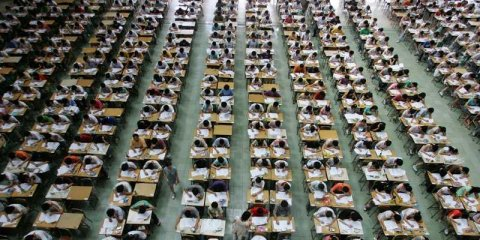
Apparently, there are about 9.5 million young Chinese entering college each year, and the photo shows them trying their National College Entrance Tests. We are looking here at China’s future.
A similar story was experienced studying the shift of manufacturing to key regions of India. Back home, while politicians are trying to find jobs for people displaced by global competition, employers are all complaining about the shortage of skilled labour. And India is the place to look.
One shortage is computer programming, and an employer who sat with me on a government task force employed over 1000 programmers in Bombay. And they cost about a third of a comparable employee in Canada and the US.
It is this unlimited supply of disciplined, educated young workers that guarantee India’s future.
Different conclusions came from my trip to Rio de Janeiro, and Sao Paulo in 1989, where we were told in Rio not to use public taxis. All the hotels and shops have their own transportation.
And the poverty. On our first morning, we watched dozens of people swarming over our hotel garbage. I was never so upset in all my life.
And the scariest warning of all was not to walk around in public with anything but a little cash in your pocket. So, no picture taking. They said at the hotel that we would be beaten and robbed only fifty feet from our five-star hotel if we were seen with anything of value. And who are these people that prey on tourists? Just a small army of homeless youth. What a waste.
A special shock was going to a cocktail party at the home of our host of the 16th Congress in San Paulo, and seeing the house surrounded by a 12-foot wall, and 24-hour guards walking the property with automatic rifles.
How can any nation develop with such a large part of the population not properly integrated into the broader society?
There are so many developing nations that I have visited with large parts of the population living in desperate conditions, and yet their leaders have hidden Swiss bank accounts.
But, the worst experience was the Soviet Union in 1988 and discovering that a society that could send a man in space could not make a simple door in a so-called four-star hotel. It was with humour that we noticed our hotel door room was so badly made that we could put our hand through a space at the top when the door was closed.
And you did not walk close to public buildings because bits of plaster were always falling out from between the bricks.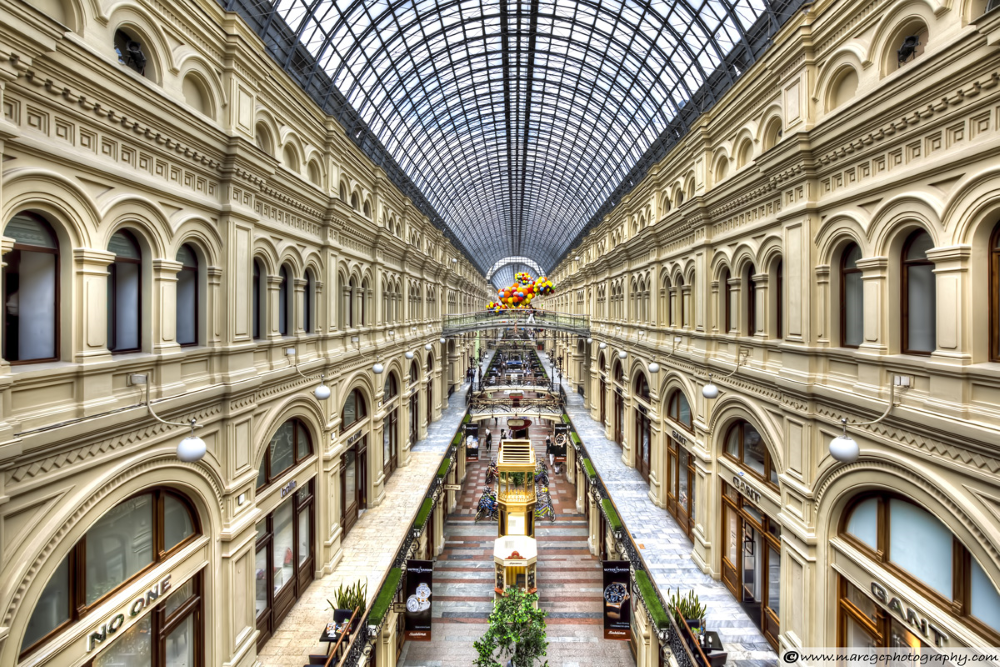 Our group played a game going through the famous GUM department store in Moscow. We would look to see if there was anything we would keep if it was given to us. There never was.
But the scary experience of our group was having the staff at the government stores cheating them on their change at every stop.
Something must have happened to the Russian culture from years of denial, and that is the only way we could explain such widespread stealing and cheating. People even removed their hub caps on their wheels, and took off their wind shield wipers when they parked their cars.
Hard to see anything but high-priced oil helping this nation.
All nations go through good and bad times, and the BRIC or BRICS are no different. And my experience over the years has been the difficulty of economic forecasting. No one really does it well.
However, if a nation is not focussed on building a culture that supports opportunity for all its citizens, and is not properly training and educating its youth, you do not need an advanced degree in economics to predict they are not going to be players in the economy of the future whatever it eventually looks like.
That’s the way I see it anyways.
05-02 BRIC
(blank) » John Bulloch » 25 Quirky Opinions » 05 Globalism »
It was to be Brazil, Russia, India and China that would fuel economic growth. But it is India and China with their skilled work forces.