Isn’t it interesting that if you boil salt water, the steam will not contain any of the salt. So, if you can condense the steam you have drinkable water. This process is called distillation and is the basis for one form of desalination.
When the Canadian navy was trying to build public support for purchasing a fleet of submarines, I was asked to take an underground trip in a vessel that had been bought from the British.
I asked them about fresh water, and they said that they just take in lake water that is then filtered. But when out in the Atlantic they use their own desalination process. And it was based on distillation.
Without getting too “techy” the distillation form of desalination is very costly and energy-intensive. So, it is no surprise that this form of desalination is found in the Arab nations like Saudi Arabia.
I had a minimal introduction to desalination as an engineering student in the 1950s, and was told that desalination is a final step to dealing with water scarcity.
My colleagues in Civil Engineering were more focused on things like treating sewage to create clean water, water diversion and storage through dams, various forms of water conservation and that sort of thing.
But travelling to places like Australia and Singapore over the years made it clear to me that most advanced technological societies would need to employ some form of desalination to meet their future needs for fresh water.
The most dramatic educational experience was the week spent in Israel in 1995. It was the occasion of the 22nd International Small Business Congress held in Tel Aviv. I got the immediate impression that Israel was a nation of science and Tel Aviv a most inspirational city to visit.
So many PhDs, so many world class researchers, so much unique technology. They were talking about issues of solar energy and water technologies even in the mid 1990s.
I was told that the nation was planning major investments in desalination, but that the immediate focus was on taking sewage and waste water and treating it for usage in agriculture.
Apparently, no nation in the world reclaims such a high percentage of its waste water compared to Israel. The first thing they do is filter it through sand.
I followed Israel’s progress as they started to develop desalination plants ten years later. They used a technology based on passing sea water through membranes that took out the salt. It was a process that was less energy-intensive than distillation.
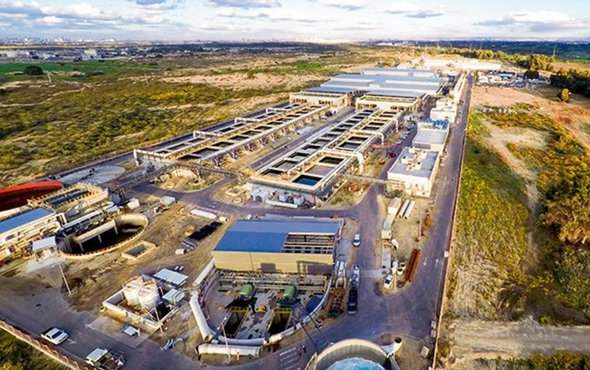
The photo shows the desalination plant at Sorek, in Israel. There are now five of these plants located along the Mediterranean. Apparently 55% of Israel’s drinkable water now comes from desalination.
But what has fascinated me is that Israel now has surplus water with the capacity to turn its deserts into fertile farm land.
And, of course, they can sell their technology. And the new desalination facility near San Diego, California is based on Israel desalination know-how.
It has been an educational process examining the future of desalination as we face rising temperatures, increasing populations and water scarcity around the world.
But, in the interim, it is so amazing what sophisticated societies are doing before taking the leap into desalination: treating sewage for farming; engineering crops that use less water; discouraging gardening and the wasteful use of water; pricing water properly; using what is called drip irrigation instead of flood irrigation for farming; and on and on it goes.
Love the evolution of drip technology that uses underground pipes to drip water on the roots of plants as a way of using less water in agriculture.
But no matter how smart we are in using water wisely, the future is desalination. It will be used to reduce conflict between nations as the supply of water becomes a life and death issue.
14-03 Desalination
(blank) » John Bulloch » 19 Global Issues » 08 Water »