When I use the term “sweet and sour” I am not thinking of ordering Chinese food. Sweet in crude oil language means low in sulphur and sour means high in sulphur.
The other important language is “heavy and light”. With light crude having a higher portion of the distillates used to make gasoline and diesel fuel. And heavy crude means more heavy residuals when the crude oil is refined. More bunker fuel oil and asphalt. The super crudes are all “sweet and light”. They serve as benchmarks for purposes of pricing. These are Brent crude from the North Sea and West Texas International (WTI) from “take a guess”.
In my early life as a lubrication and power engineer, I worked at refineries in Ontario which were “simple” refineries. This meant they could not process heavy or sour crude. And those light and sweet crudes from Alberta are still available but in lesser quantities.
And as a matter of interest the oil from Hibernia off the coast of Newfoundland is light and sweet. And if you are really interested those Ontario refineries that were near Toronto are all gone. They disappeared when natural gas replaced fuel oil. And they could not process the crude oil that would be coming from the tar sands of Alberta.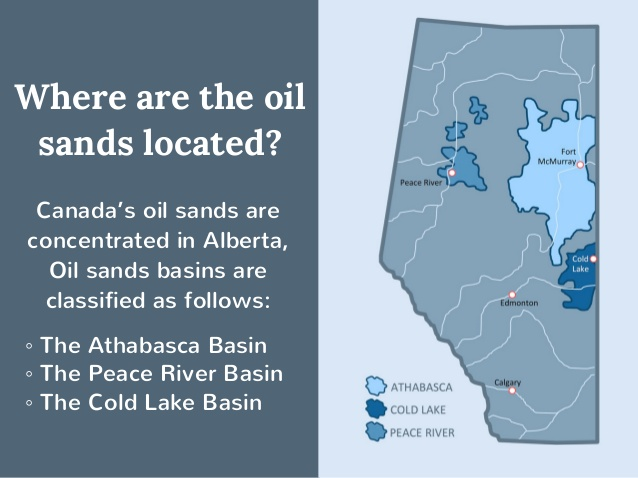 The Alberta Tar Sands (they like to be called the Oil Sands) is at the centre of Canadian economic and political life. It is so easy to be a minor political party. So easy to want to close down the tar sands and turn the market over to Venezuela and Mexico. I mean who really cares about the millions of dollars per day that the federal and Alberta government have at stake when it comes to getting our oil to market. The attached shows where the tar sands exist in Alberta.
The bunker fuel oil I sold in 1959 was the residual bunker fuel from the old Cities Service Oil Company in Bronte Ontario, and it was low in sulphur. It could be sold today to the cargo ships that want low sulphur bunker. But bunker fuel oil from conventional crude is like the bituminous content of the tar sands. Neither can be transported unless they are either diluted or heated.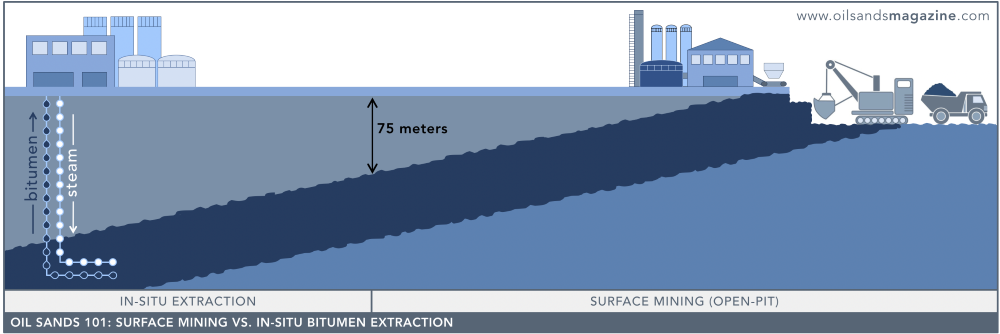 The diagram explains how the bitumen from the tars sands are exploited. Not simple, because the tar sands are only about 10% bitumen and the rest a mix of water, sand, clay and other goodies.
The stuff from down deep is heated with steam and brought to the surface and put through a process that not only removes the sand and water but produces more light crude and less sulphur. It is referred to as synthetic crude. The stuff that is mined on the surface is just diluted with lighter material that makes it pumpable.
The final product that is shipped to refineries in Canada and the United States is a blend of conventional oil, diluted bitumen and synthetic crude. It is called Western Canadian Select (WCS). And it is a high sulphur product. But all the refineries being built today can handle heavy and sour crude because the supply of the light sweet stuff is in decline.
Our WCS is discounted in price because of its sulphur content and because it is so hard to take to market with the lack of pipelines. We have the debate over the expansion of the Trans Mountain pipeline and this is all about Canadian politics and court delays.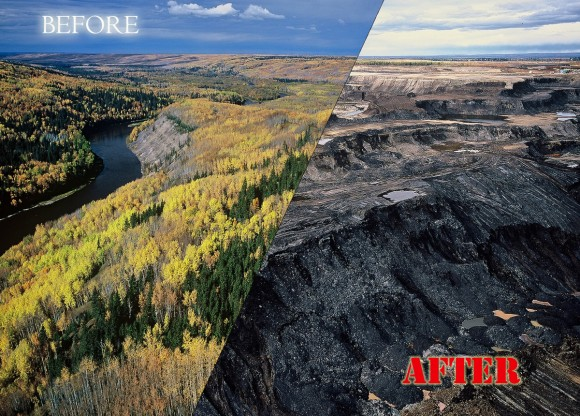 This does not mean the environmentalists do not have a case. When conventional oil spills on water it floats on the surface. Spill crude from the tar sands and the heavy stuff sinks to the bottom. Serious pooh. The before and after photo makes another point. Not pretty.
03-07 Tar Sands
(blank) » John Bulloch » 19 Global Issues » 03 Oil and Gas »