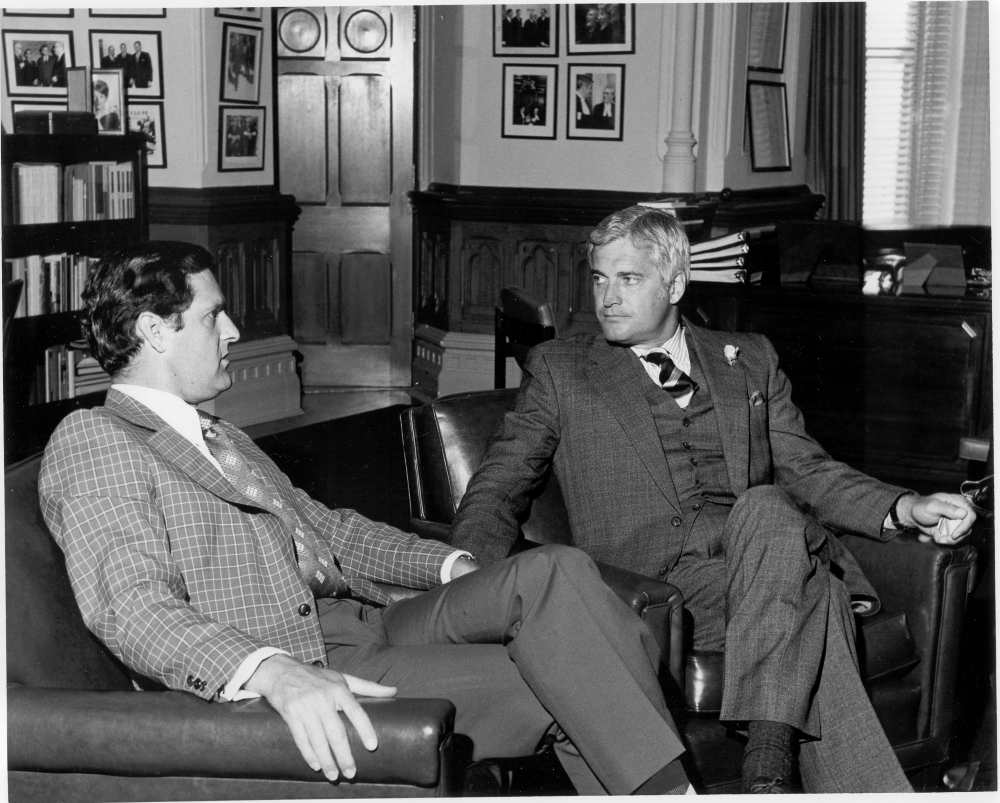
 The White Paper victory over the dramatic changes to the Income Tax system proposed by former Minister of Finance Edgar Benson had to be transferred into new legislation and passed through the House of Commons. That job was given in 1972 to John Turner, the new Minister of Finance, and his able Deputy Minister of Finance, Simon Riesman.
Mr. Turner was not only capable but philosophically sympathetic to our proposals for a lower corporate tax rate for small business. He implemented a corporate tax rate of 25% on the first $50,000 of business income and with a lifetime ceiling of $400,000. As well he put into legislation the taxation of capital gains at a 50% rate and not a 100% rate, and the elimination of estate taxes. These were the basic significant changes in the new Income Tax Legislation of 1972.
It was a special further victory in the Turner 1974 budget that the low rate was applied to $100,000 of business income and the lifetime ceiling raised to $500,000.
But to my surprise during the Turner years, once the drafting of legislation began, important changes were made that were too technical for any kind of public debate. Hundreds of changes only showed up as part of the fine print in the budget papers, sections that are only read by tax specialists. John Turner handled this process well and the result was a better tax system.
It certainly demonstrated the limitations of the political process in dealing with anything technical. And to my surprise as well, a considerable section of technological changes that were part of the White Paper process just disappeared. The Minister discovered, as our technical advisers had, that a huge portion of the technical changes in the White Paper were private agendas of Department of Finance bureaucrats.
In some cases, we were dealing with a federal tax lawyer that was engaged in a private war with a private sector tax lawyer. It is an old game. Bureaucrats design technical sections. Private sector lawyers earning twice their salary find a way to work around the law. Then the bureaucrats design a new section, and on and on it goes.
And following the federal tax initiatives in 1972, and the introduction of a deemed capital gains tax on death, all the provinces eliminated Succession Duties. During the tax battle we called the combination of a capital gains tax on death, federal estate taxes and provincial succession duties, the "Triple Whammy". It was designed to destroy private pools of capital.
The wealthy could afford the lawyers and accountants to put their assets into trusts in places like Barbados. Not so for the rest of us. We were fighting proposals designed to destroy the middle class—it was a simple as that.
Be assured that if there is a technical component in any important legislation, also assume that the really important changes are in the fine print. This applies to public issues other than taxation, like trade, climate change, competition law, bankruptcy law and on and on. And what chance does a small firm have dealing with a multitude of complex technical issues without the Canadian Federation of Independent Business?