The key tool in building membership for the new Canadian Federation of Independent Business was the Mandate Ballot. Nine times a year the members received a ballot with four questions on public policy issues that were on the top of the public agenda. Their positions provided us with the ammunition we needed when presenting member views to federal and provincial politicians. As someone with a high school teacher’s certificate, I was pretty good at designing valid questions, but understanding the pros and cons of a complex issue was challenging and hard work. I can remember spending a whole night in the Toronto Star library and falling asleep in a chair.
But I made my first blunder, and that was to design a simple ballot that they could tear off, vote their position, and then fold, staple and mail. How was I to know that the members, to protect their privacy, would put up to a dozen staples on their ballot? So now I had created the first function at CFIB, and that was to take the staples out of the ballots. At night Mary and I would come down to the office and clean the washrooms and vacuum the rugs. I can still hear that sound of Mary’s vacuum cleaner sucking up the staples.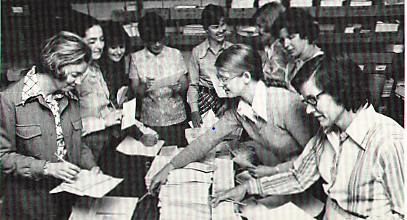 A group of wives added up the Mandate ballot votes during the evenings each week. It was called the Tabulation Centre, and what fun they all had together. Heather Sherk headed up the Centre for 35 years. Heather can be seen second on the left in the photo. My wife Mary can be seen at the back. We could never automate this process over the years, because each envelope containing the ballot would also include cheques and little notes, “Tell John to do this, tell John to do that.”
Years later, as members in increasing numbers voted their ballots online, the Tab Centre function became obsolete.
Another critical component of the membership sale was filling out a form that would eventually give CFIB a massive database. Part of the reason there is so little proper research on small business around the world is that governments do not have small business databases. We wanted information on the size, type, age and the number of employees and other detail. And if every question was not filled out by the District Manager, I held back his or her commission. I was extremely unpopular for two years. No one could appreciate what I was trying to do.
I wanted to know, of course, how small firms felt about the issues, but I also wanted to know if their views were different for firms in Atlantic Canada vs British Columbia, or how different for established vs new firms, for female vs male owners, for manufacturers vs retailers and so on.
But when the Mandate positions became media stories and helped our District Managers make new sales, the circle was complete. And my vision was a success. We had created a sales function that was the cornerstone of our small business research function. We were soon to develop a sales or field operation that attracted crusaders from across Canada. 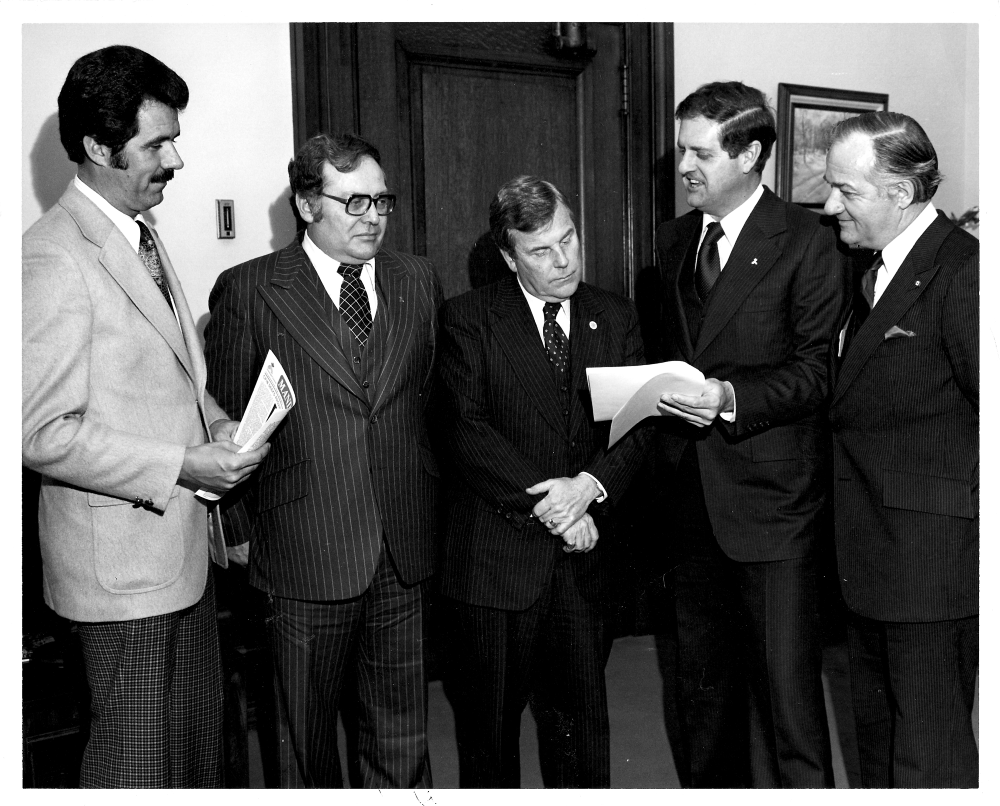 And it became a basic function of our meetings with politicians to explain how the Mandate process worked. The attached photo shows me describing how the Mandate works at a meeting with Premier Sterling Lyons of Manitoba with our Prairie Division Manager Jim Plosz and two senior cabinet ministers.
In business, leaders are required to make difficult decisions. And often, no matter how much you try to explain what you are doing, you are very unpopular. The real challenge when you make principled decisions is to have the guts to stick to your guns.