It was the Canada-US Free Trade issue all over again. Not surprisingly, the CFIB membership supported the expansion of the free trade arrangement with the US to Mexico. Again, we were asked to join an important advisory committee whose purpose was to win public support for the potential new trade agreement.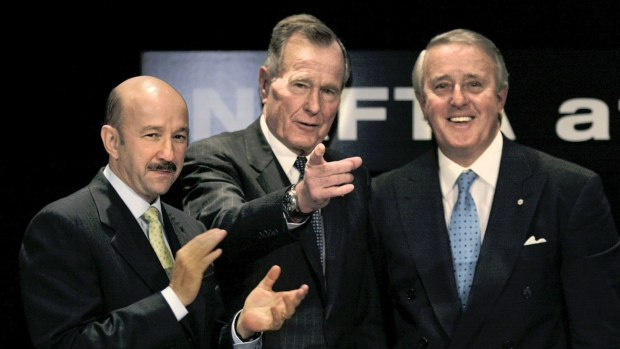 The Agreement was initiated by PM Brian Mulroney, President H W Bush, and President Carlos Salinas de Gorton in 1992 to come into effect January 1994. In an historic photo taken ten years later, the three former leaders celebrated their achievement.
These advisory committees were a tremendous learning experience. We were advised that it was President Bush who was the promoter of the concept. He firmly believed that if the Mexican economy could be encouraged to grow substantially as the result of free trade with the US, then illegal immigration to the US would not only stop, but be reversed.
Canada was not a large trading partner of Mexico, but we could not be left out of a free trade arrangement between the US and Mexico. We were told that Bush wanted to encourage free trade between the US and a range of Latin American nations which would threaten our access to the US market.
Again, I was amazed by just how complex these trade agreements are and how only about 20% of these deals can ever be explained politically. By the time NAFTA would be in effect, all the tariffs between Canada and the US would be gone, so most of the discussion of the issues involved were other matters like the rules associated with investments in Mexico. The major corporations would not invest if they could not sue Mexico for subsequently changing laws that would impact the viability of their investments.
What was so interesting was the discussions of business leaders compared to those of political leaders. Politicians talked about the need to have rules around labour standards and the environment to justify the transfer of unskilled jobs to Mexico; whereas the business leaders were discussing the shortage of skilled labour in Canada and the US and the future skilled labour pool being developed in Mexico.
The politicians discussed in general fuzzy terms how growth in trade would lead to prosperity and jobs. Business leaders discussed in detail their preference for having joint production facilities in Mexico rather than moving their production to China. From their perspective, they had to move semi-skilled and unskilled jobs out of Canada and the US to compete globally regardless of an agreement with Mexico.
Business leadership by nature thinks long-term and political leaders tend to think from election cycle to election cycle. What I learned during the NAFTA debate was that at some stage, Mexico with a population of 80 million, would become a powerhouse economy.
Someone asked the question during one of our private sessions what would happen if the US at some stage wanted to get out of NAFTA. The answer was that it could happen, but to put the former tariffs in place would take the support of Congress. And the winners and losers in a trade agreement are not spread about equally across the US, so getting the support of a majority in Congress would be difficult. We were also told that if the US did get out of NAFTA, the Canada-US Free Trade Agreement would still be in effect.
Trade Agreements are excellent tools for politicians to promise to change at election time, but seldom do anything about it once in power because of the complexity and wide range of interests associated with trade agreements. It is the same argument when politicians promise to simplify the tax system.