When the MacDonald Royal Commission Report in 1985 recommended that Canada enter into a Free Trade Pact with the United States, it was apparent that we were at a time of historical importance. Donald MacDonald called it a "Leap of Faith."
The Mulroney government agreed with the Royal Commission’s recommendations and capitalizing on an excellent relationship with President Ronald Reagan of the US, entered negotiations.
At CFIB we had a strong mandate in support of free trade, and a consistent level of support for all free trade agreements going forward. The majority of our CFIB membership seem to recognize initiatives that are supportive of growth and change, and in terms of what might be called Small Business 101, growth and change stimulate entrepreneurship and new venture formation. In 1987, I was asked by the US Senate and House Committees on Small Business to come down to Washington to testify on the small business perspective on Free Trade. I was nervous about how technical the sessions would become so I asked the head of the Canadian negotiating team, Simon Reisman, for a private briefing. Mr. Reisman had been the Deputy Minister of Finance when John Turner introduced the major changes to the tax system in 1972. In terms of quality public servants, Simon Reisman was in a class by himself. He was enormously helpful.
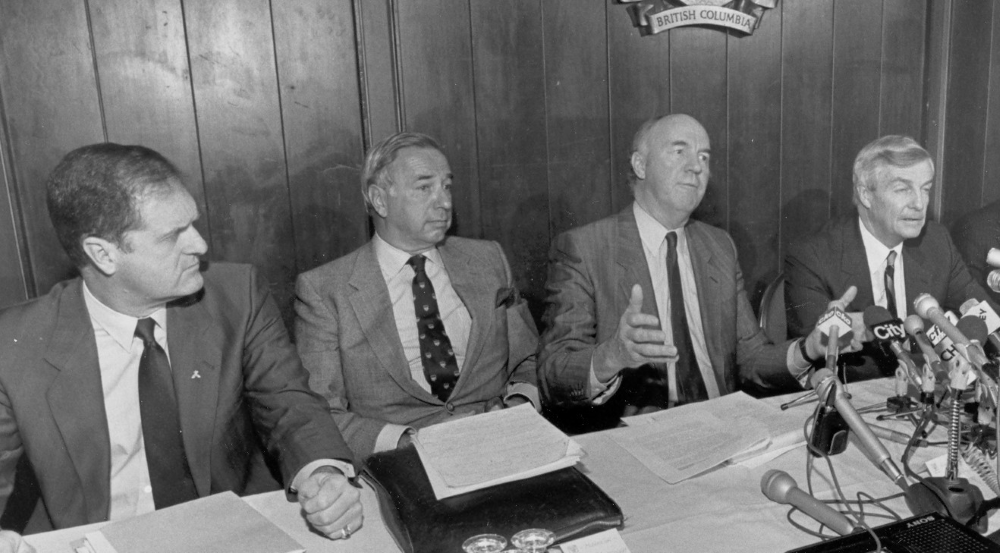 Selling the Free Trade concept to the public was important because both the Liberal Party and the NDP were opposed. Donald MacDonald struck a task force that went across Canada, and CFIB participated in a number of public events. In the photo, I am sitting next to Darcy McKeough, the former Treasurer of Ontario, and next to Donald MacDonald is the former Premier of Alberta, Peter Lougheed.
The FTA, as it was called, was negotiated in October 1987 and signed by the government in January 1988, but the Liberal Opposition said they would cancel the Agreement if they were elected to power. So, the general election of 1988 became the Free Trade Election, and the Mulroney government secured another majority.
Over the years, I discovered some nations consider protectionism as the best way to protect and grow small business, but in every case, this protectionist philosophy is at the expense of the consumer. In true free enterprise cultures that put the consumer ahead of the producer, free and open trade forces the small business sector to continuously change and adapt to the benefit of all sectors of society.