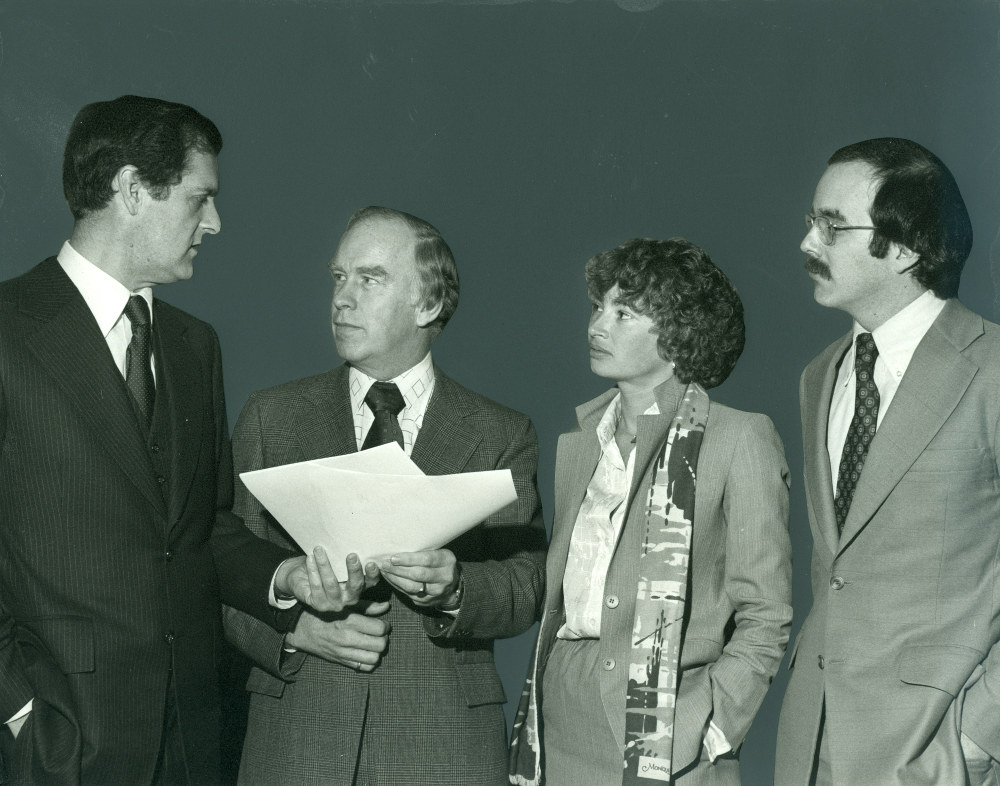
 1978 was a year of magic in the history of the Canadian Federation of Independent Business. We achieved our membership goal of 50,000, making us the largest voluntary small business advocacy organization in the world relative to the size of our population. We started to build a policy and research capability with the appointment of Pat Johnson and a Provincial Affairs Department with the hire of Brien Gray. We had the ear of all the governments regardless of the political party in power. See the photo of Pat, Brien and myself with the Treasurer of Ontario, Frank Miller, who later became Premier.
But the big story of 1978 was the final pay off from collecting massive data on our membership that was only possible because of our personal calls each year. We had exclusive data on their employment history over a period of seven years. Pat, as an economist, massaged this data, and produced a report that showed small firms creating the most jobs in the Canadian economy. The release was a blockbuster and picked up by the media across Canada and the US.
Up until then, the argument for supporting small firms was the dynamic role they played in community development, the support of families, income distribution and social cohesion. Now the new rationale was job creation. The power of numbers, numbers.
And it was amusing how the established economists criticized our methodology. They simply couldn't appreciate that they were so involved studying government data on large corporations, that they had missed what was really going on in the economy.
Well to our surprise, after our press release made such a splash, we had a visit from a young physics professor from the US, who said he had access to a large US small business database and did not know what to do with it. A colleague suggested he visit the CFIB in Canada.
His name was David Birch, and his research and press release showing the dominant role of small business in the US economy was a global blockbuster and made him an instant media star. After that research explosion, governments everywhere began gathering quality data on small business job creation. The impact on public policy was massive.
Both David Birch and I received fellowships from the International Council for Small Business – a global organization made up of academics and advocates specializing in small business and entrepreneurship.
Always be suspicious of so-called consensus positions of academics because research is only as good as their data, and so many of them rely on the same databases for their research. CFIB created a revolution in the way governments focus on small business, not just in Canada, but around the world.