I used to think that most of Quebec was bilingual, but once you move into rural Quebec, you discover they are unilingual French just as we are unilingual English in most of English Canada. It was a challenge of a lifetime building a truly national organization.
We moved into Quebec with vigour in 1976, building a Quebec division around a young and dynamic recent hire called Michael Hamel. Michael has served the Canadian Federation of Independent Business (CFIB) with distinction for over 40 years. We were pleasantly surprised when received with enthusiasm by the Quebec small business community. To support our growing membership base, we began to hire a robust bilingual staff in Montreal and the head office.
We noticed Quebec members were less ideological and more pragmatic than our members across Canada but, on most issues, they shared the same views as small firms everywhere. But the good news was that with a large French-speaking membership base, our influence increased substantially.
Being bilingual was only part of our challenge in Quebec. The big issue was dealing with the election of the Parti Quebecois in the fall of 1976. Then came referendums and political unrest that did not make the job of building a division easy for Michel Hamel. 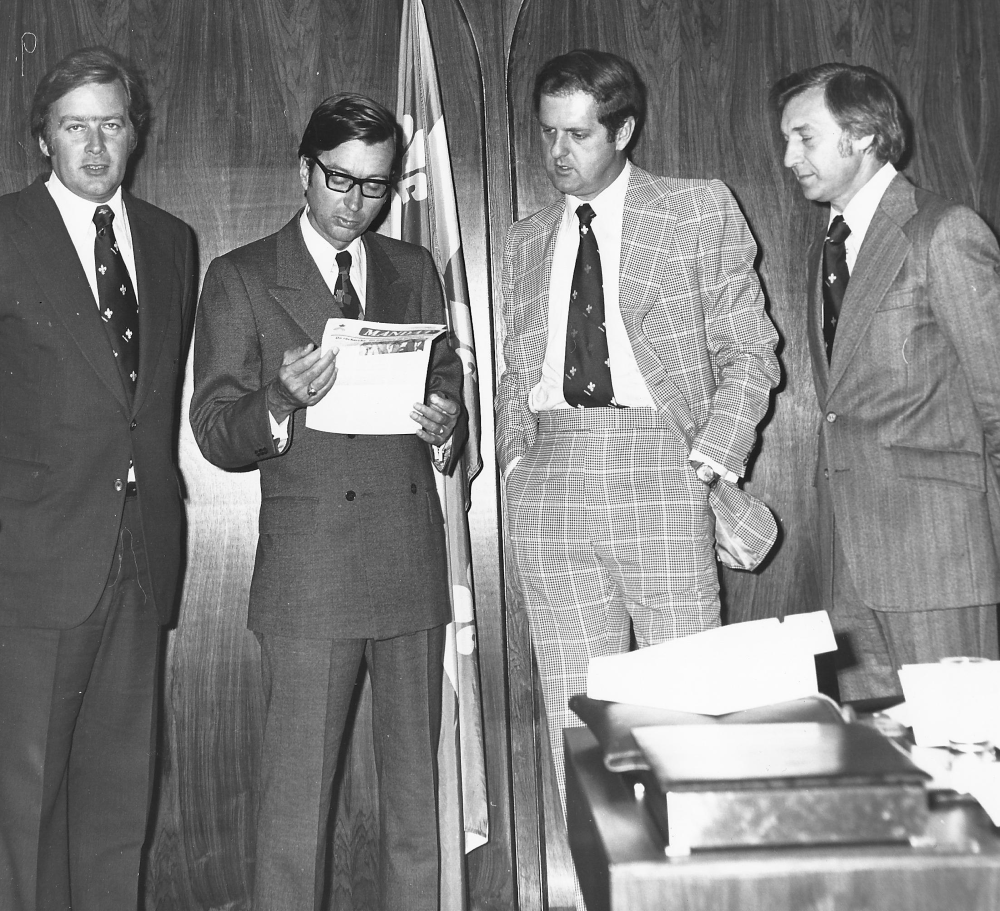 We were well received by Premier Bourassa in the fall of 1975, and like all the Premiers, he was fascinated by the Mandate programme that gave us a membership vote on all the issues. He called our system of building consensus ingenious. I told him we were working towards a goal of 50,000 members, of which 25% would be from Quebec. Our two governors from Quebec, Ben Sevack and Jacque Turquotte also attended. In the photo, Jacque is on the left and Ben is on the right. The Premier is seen studying our Mandate ballot.
At the beginning of the meeting, I was impressed by his courtesy to ask me if I would be more comfortable if the meeting were conducted in English. In contrast in 1977, when I held a meeting with the separatist Premier Rene Levesque, he led the meeting with our Quebec Legislative Director and myself in French, even though he was fluently bilingual. I got the message.
After the Bourassa meeting, the Premier's Chief of Staff asked me to stay behind. I received an offer that staggered me. He said the government would insist that 1,000 of their suppliers join the CFIB, but in turn, CFIB would have to put on its Board a representative appointed by the government. Thanks, but no thanks. The message, however, was clear. The Premier thinks we are going to be politically powerful.
Our membership renewal for the first 20 years was 82% in English Canada and only about 72% in French Canada at first but rising to 76% as we built a legislative team with strong spokespersons. But as we increased the number of value-added benefits to the membership package, the differences narrowed. Now under the current President, Dan Kelly, the membership renewal rate is 85% everywhere, the highest of its kind in the world. CFIB is doing something right.
One of the great joys building CFIB was building the respect and support of small business everywhere in Canada. But building our base in Quebec required more than functioning in two languages. It required strong Quebec staff with a large degree of autonomy to reflect their own distinct culture and way of doing things.