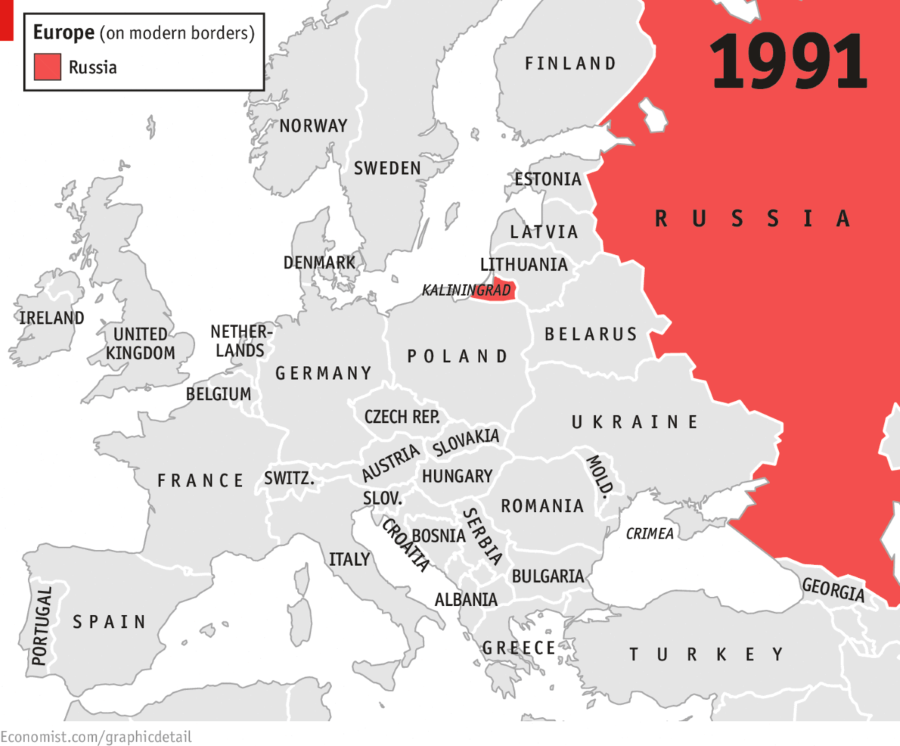
The map of Europe after the collapse of the Soviet Union in 1991 clearly shows the geopolitics – a much larger and stronger Europe and a much stronger western alliance led by the United States.
The impact for Russia was quite dramatic. Not just because of the economic shock, but because so many Russians were now living in less friendly nations that were part of the former USSR.
It was later in 1996 that I was in the Ukraine to promote the use of online learning. And visiting with the Canadian Ambassador in Kiev, I was told that what makes the development of Ukraine so difficult is the large number of Russians living in Eastern Ukraine who have a primary loyalty to mother Russia.
So many things have happened since the collapse of the old Soviet system. We had a resurgence of Russia with a focus on the export of natural gas. We had increased public support for the Russian Orthodox Church. And most importantly, after the Russian pull out of Afghanistan, there was a reduced appetite for military adventures. And most certainly their young people developed a taste for a Western-style standard of living.
But for me, the major geopolitical event associated with the collapse of the Soviet Union was the creation of a US-dominated global economic system. The US now controlled the seas, and their large global companies were active everywhere in the world, especially with the new members of NATO that were formerly part of the Soviet Union.
Globalism began back in the 1970s to prevent the spread of communism in South East Asia. The promoter was Peter Drucker, a respected management consultant and adviser to a series of US presidents. He made the point that the greatest threat to the west were the armies of educated young people coming into the job market of the less developed nations. And if American business does not help provide jobs, these societies would collapse.
And that was the beginning of a US investment boom in nations like Taiwan, South Korea, Thailand, Indonesia, Malaysia, Singapore and the Philippines.
President Putin in later years referred to the collapse of the Soviet Union as "the greatest geopolitical tragedy of the 20th century." It indeed was a great geopolitical event.
But how could anyone consider the Soviet Union anything but an artificial arrangement? So many different languages and cultures. It really collapsed because mother Russia could not continue to finance the massive subsidies and military that was necessary to keep it all together.
Now the great debate is the future of globalism. Are those opposed to the US-dominated economic system working in the best interests of the US or in the best interests of Russia? Perhaps they are just opposed to the success of global democratic capitalism as an economic philosophy. Or, as a final option, they would prefer to turn the global economy over to China with an economy that will soon be larger than the US economy. Let China pay for the armed forces the US now has in place around the world to protect its empire. Nasty options.
02-03 Geopolitics
(blank) » John Bulloch » 13 Russia » 02 The Collapse »