Grandpa Halter joined WWI as a volunteer in 1914 leaving a young wife with two children, our mother age 3 and her sister Rae, age 2. Our grandmother Halter was enterprising and arranged for “Eatons” to send work home so she could enjoy income to supplement grandpa's army pay. Grandma Halter was an alteration tailor and had done needlework of one kind or another since the age of five in Romania.
Joining the war as a volunteer was such an act of patriotism. Grandpa was not pressured in any way. It is part of our history that although Canada provided a volunteer army during the years 1914-1917, there was enormous coercion to join. Recruiting officers used to call on young people in public theatres to stand up if they had not enlisted in the army. And a national organization of women pinned white flowers on young men who had not joined up.
There was conscription in 1917 because so many young people had died. In two significant battles, Vimy Ridge and the Battle of the Somme, 34,000 young men were killed or wounded, and all had to be replaced. 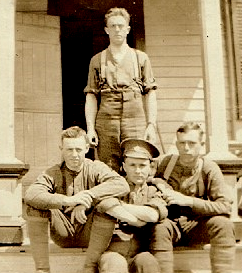 Within a year in France Grandfather Halter was promoted to sergeant and led soldiers in training through an exercise routine to prepare them for battle. In the 1916 photo, he is seen standing with some of his buddies.
He suffered from a mustard gas attack and was sent home in 1917. I used to ask him as a child what it was like to be in a war and he always said, "Too horrible, too horrible." But because of lung damage, it took him 30 minutes each morning to clear the phlegm from his lungs so he could breathe properly.
But his real affliction was Buerger’s Disease (a rare circulatory problem today), but common then because of the long stretches soldiers slept in the trenches. At one period in 1916, Grandfather Halter went for three months in the trenches without lying down to sleep or removing his shoes and socks. He went through a dozen operations in Canada having veins from his back inserted in his legs.
For a period of about 25 years after coming home, Grandpa spent two to three days a week in the old Veteran’s hospital on Christie Street near Davenport.
My mother was a volunteer at Christie Street and worked there for years. I remember spending Saturdays at the hospital playing in the special playroom with all the other kids that had sick Grandpas.
And I remember as if it were yesterday, visiting Grandpa and playing checkers. Once when he was called away for treatment, I continued playing with a gentleman in the next bed. He had no legs.
04-01 Grandfather Halter
(blank) » John Bulloch » 03 Family Treasures » 04 Childhood Memories of War »