"The Americans are bastards." This is a quote from Simon Reisman, three years after he negotiated the Canada-US Free Trade Agreement in 1987, and he was referring to the aggressive approach American business was taking to the new trade rules.
Mr. Reisman negotiated the auto pact in 1965, and was the Deputy Minister of Finance in 1972 when Finance Minister John Turner introduced major changes to the tax system. 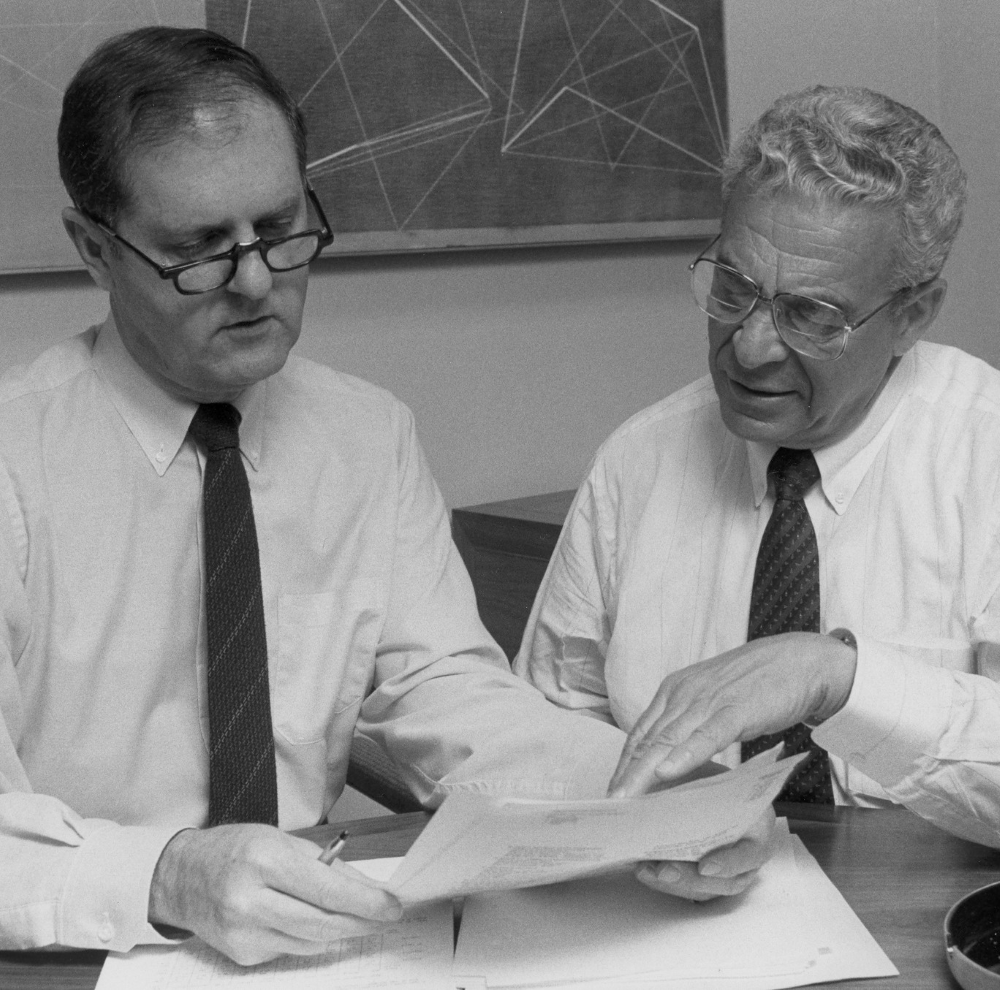 I found Simon Reisman to be an extraordinary public servant, crusty for sure, but someone who really knew his stuff. In the photo, he is giving me a private briefing in advance of my trip to Washington where both Committees of the Senate and House of Representatives wanted to know the Canadian small business position on free trade.
Small firms generally approve or disapprove trade agreements in a 3:1 proportion, mostly because they know trade expansion stimulates growth. And although about 80% of trade agreements are about free trade, they have a significant interest in the 20 per cent that comes under special rules, usually agriculture. Small firms are integrally linked to their agricultural communities.
Trade Agreements are bloody complex, and today trade in manufactured goods are really sales between a highly integrated chain of suppliers. Trade may also be linked to the functioning of a “contract manufacturer”, who can provide all the components for a product assembled in say, the US, from companies they own in China, Mexico, India and Brazil.
If you look at a lot of yesterdays going as far back as the imposition of US tariffs in 1930, just after the stock market crash, we have a prime example of US protectionism. It made the world-wide recession worse and helped the rise of nationalism in the form of Adolf Hitler. Canada sought new trading arrangements with Britain to compensate for the loss of US markets.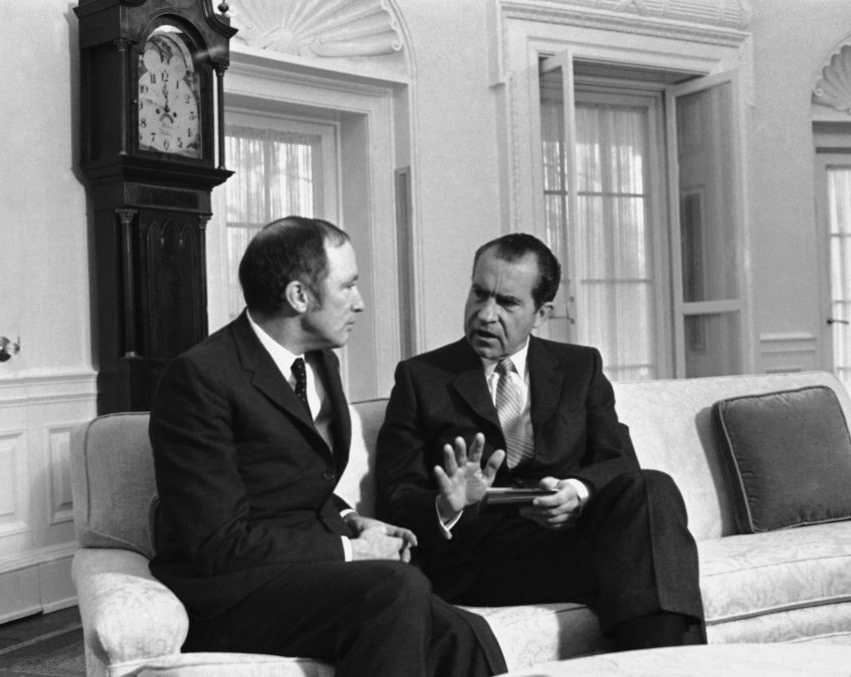 Canada is very vulnerable when the US moves into a protectionist phase, something that seems to happen every ten years in some form. We are a very spread out country selling cars, resources and agricultural products mostly to the US. So, the first thing a new Prime Minister does is try to cement relations with the current American president. In the photo, we have Prime Minister Trudeau meeting with President Nixon in 1969.
Unfortunately, Richard Nixon and Pierre Trudeau were like oil and water, and that probably best describes the relationship between Donald Trump and Justin Trudeau.
The US went into one of its protectionist periods under President Nixon, and in 1971 Nixon imposed a 10% surcharge on all imports. He said that Canada had cheated and caused the loss of US jobs and investment, and he threatened to cancel the Auto Pact. Sound familiar?
Canada's response was to diversify trade with Europe and Japan, strengthen Canadian ownership, and protect Canadian culture.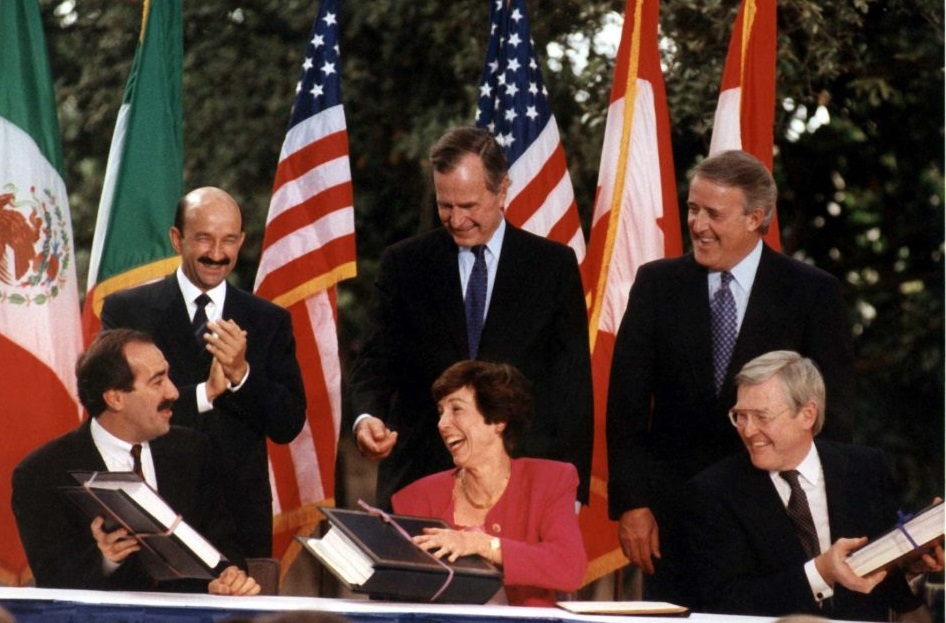 We then enjoyed a period of exceptional growth and prosperity based on a new and unique relationship with the US under Prime Minister Mulroney. His secret was a very personal friendship with both President Reagan, which gave us the Canada-US Free Trade Agreement, and H W Bush, which gave us the North American Free Trade Agreement or NAFTA. The photo shows PM Brian Mulroney, President H W Bush and President Carlos Salinas de Gorton and their key negotiators signing the NAFTA in 1992.
I have clear memories of the NAFTA negotiations as a member of the Federal government’s Advisory Committee. The pressure on the deal was coming from the US and not Mexico or Canada. But major corporations said they would transfer a lot of standardized production to Mexico rather than to China.
And another memory was a discussion of the future of Mexico and the strategic importance of the growth of their skilled workforce. It was a constant complaint of large and small companies in both Canada and the US that our economic system was not providing the needed supply of skilled workers.
The lessons from all the yesterdays?
Always expect the US to move from openness to protectionism to openness. Their system does not ensure their workers as winners. More US jobs does not mean more skilled jobs.
No nation can count on the long-term benefits of free trade unless they are continually upgrading the skills of their workers and providing a robust social safety net, something you find in Europe, and to a lesser extent in Canada. US protectionism is as American as “apple pie”.
04-01 Yesterday
(blank) » John Bulloch » 10 Canada-US Relations » 04 Trade »