After about fifteen years from start-up, the basic advocacy model that took us forward was in place. This chapter recognizes the strategic builders who made it possible.
The first was our first District Manager, Bob Brouse, who was hired from a referral from the tenant in our first office at 745 Mt. Pleasant. We then started hiring reps using advertisements, and for six months could not find District Managers that could make a living. When we finally figured it out, I began to appreciate that the recruitment and selection of District Managers was almost an art form. At the NFIB in the US, half their Managers used referral networks to hire salespeople and the other half used advertisements arranged by head office. Everything they did was very detailed and targeted.
The first thing I did when I figured this out was to establish an Advisory Council of well-connected members from across Canada who could provide advice on local issues and help us find people who would make good District Managers. Women in those days never answered ads and in the Atlantic Provinces, the majority of those applying for jobs were trying to protect their Unemployment Insurance payments by looking like they were searching for work.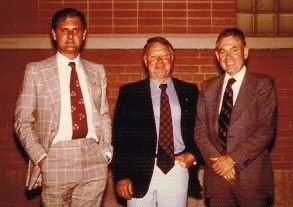 When Bob Brouse celebrated his first five years with us, Ray Sherk, the VP and General Manager and I took him and our wives for an evening of revelry. Bob is the one in the middle of the photo.
And of course, the second strategic builder was Ray, who worked in the 70s while still on staff at Ryerson, putting our basic field operation in place. It was a system which we were copying from the National Federation of Independent Business. Once we realized that you had to follow the procedures in detail Ray was adamant in enforcing this system on the Canadian operation. And because Ray was using information from outside the country, few appreciated what he was doing. For our first few years of starting our venture, it seemed everyone was trying to tell us what to do.
In the early years, Ray set all the performance standards for new business sales and renewal sales. When the division and district managers did what Ray insisted, they all started making money and CFIB started to grow.
The third strategic builder was Ralph Wallin, who was suggested by our Advisory Council member in Regina. Ralph was the superstar of the 1970s. At that time most of our focus was building strong regions in Ontario, BC and the Prairies, but Atlantic Canada was floundering, with lower productivity and fees than Ontario and the western divisions.
We sent Ralph to New Brunswick for a month and his performance, regarding sales per day, fees, increases and so on were the same as back in Saskatchewan. This was huge, proving that performance is linked to the person and not the territory. It stopped what was tearing us apart at the time, claims by every Division Manager that some part of their territory had to receive special consideration.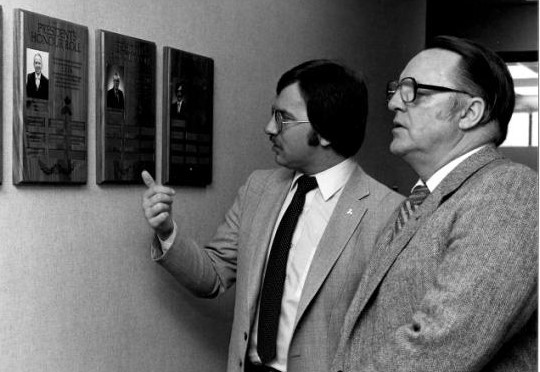 The fourth builder is Michel Hamel who was hired in 1976 and quickly promoted to Quebec Division Manager. In the photo, Michel is showing Ralph the President’s Honour Roll winners from his Division.
Michel had none of the support from me that I had given to all the new DMs in Ontario and the West with my high public profile and by speaking to Rotary Clubs with a DM present. And in English Canada, our weekly newspaper inserts and radio news tapes were reaching four million English Canadians in rural Canada each week. But Michel proved that new business success was associated with all the principals of recruiting, selecting, training and retraining and not our political action plan.
Michel gave me special back-up in Ottawa because he was bilingual and switched from being a Division Manager to a Quebec lieutenant when necessary. Over the years it was Michel who promoted the addition of value-added services to the CFIB product mix, and over time, it had a significant impact on the CFIB renewal percentages. It was 80-82% in English Canada and from 70-76% in French Canada during my day, and today, thanks to Michel, it is 85% across the Board. The improvement in renewal rates also came from strong legislative spokespersons in all the provinces, but especially Quebec.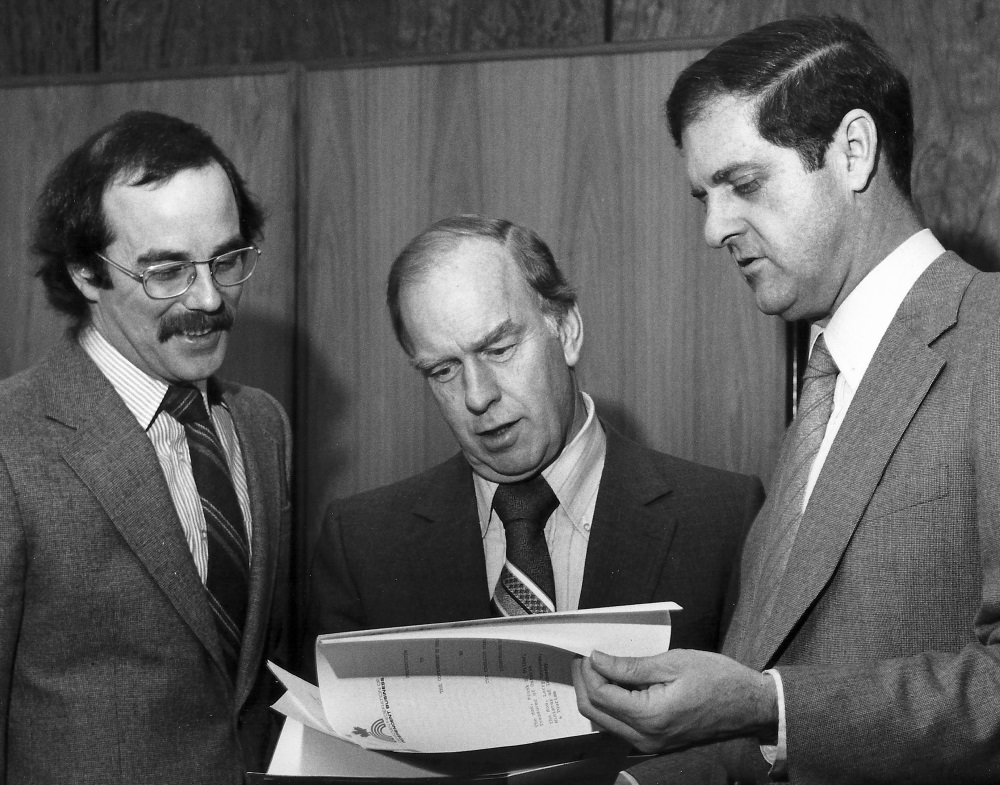 The fifth strategic builder was Brien Gray, who had a strong background in public policy and was bilingual. Trying to define the provincial affairs function was enormously difficult because nothing was like it appeared, politically. A debate in Saskatchewan about changes in labour legislation was just a matter of conforming with Ontario. Then we discover the finance officials in New Brunswick were three officials in the Department of Finance in Ottawa. It was Brien who built the provincial offices across Canada, and coordinated fights with Ottawa, where the provinces were involved. And as the provincial offices became stronger, all provided high-quality counselling services to the membership and provincial research and legislative support. In the photo, Brien is seen in the early 80s meeting with the Provincial Treasurer of Ontario, Frank Miller.
The importance of history and being able to recognize those who were strategic builders at the time, is that you discover the organization's ABCs, those basics that are forever. And often when you are stymied, the best thing to do is to go back to basics.