There are wonderful stories associated with the history of our physical facilities that ended with our amazing 4141 Yonge Street.
It started with our first 400 square feet at 745 Mt. Pleasant just below Eglinton Ave. We sublet 100 sq. ft. to an agent who sold shelving equipment which is now in our supply department at 4141 Yonge. And our neighbour was Leslie Rebanks, the architect who designed the 4141 building.
Then we bought our first building at 15 Coldwater near Leslie and York Mills. Our tenant occupying most of the garage space was Rogers Cable. And through Ted Rogers' influence, we produced a CFIB cable show called Bullseye Ottawa where I interviewed politicians.
Buying 15 Coldwater in 1973 required $60K as a second mortgage from my father, but during the three-month period between the “offer to purchase” and the closing of the deal, our field revenues jumped to such a degree the second mortgage was not required. That is when CFIB started to take off.
We grew to such a degree in the next three years that we had to rent additional space in the area on Scarsdale Road. We looked at putting a second floor on Coldwater, but that wasn't feasible.
In 1977 I secured approval from the Board to search out property suitable for the development of our own building. Governor Bob Morrow made the historical comment that we will be strengthening the future of CFIB for the next 100 years. This building, he explained to the rest of us, will be our collateral if we ever need a large loan, and the revenues from the tenants will allow CFIB to operate rent-free.
The Board created a Building and Finance Committee chaired by Bob, and when we came closer to construction in 1980, he hired a fellow Board member, Al Rioux, from New Brunswick as both project manager and our real estate agent. Al had been both a contractor and a licensed commercial realtor in his small business career.
We hired outside specialists to find a suitable location and decided on the Yonge and York Mills area because of the subway. We were going to purchase three properties totalling about 60,000 square feet of space, but Bob said a 60,000 sq. ft. building would not be viable, so we bought another 40,000 sq. ft. and paid as much for it as we did the previous three properties. 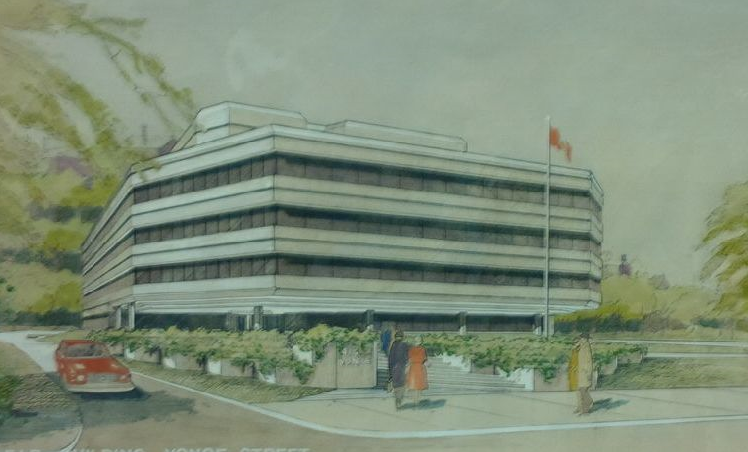 We hired Leslie Rebanks, and the Board immediately approved his proposal (shown in the attached drawing). I showed the plan to Mayor Lastman and he said he would help us through the lengthy approval process which required the support of the Church above the property, the local ratepayers’ association, city council and so on. All approvals, including by-law changes, went through on time.
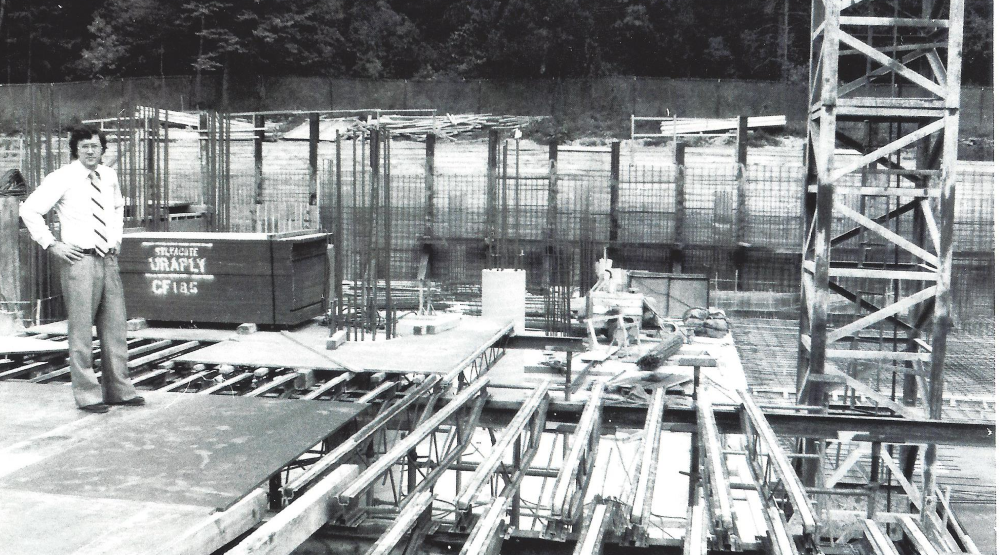 In the wonderful photo taken during the construction period in 1980/81, we see Jim Bennett standing on the site. It was an exciting time in our history.
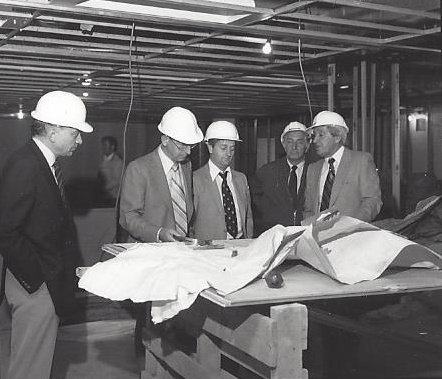 Each year after 1977, new board replacements were recruited with expertise associated with developing, constructing, selling and managing commercial real estate. And what a joy for CFIB and the members that the building was brought in on time in the summer of 1981 and under budget. And of special importance, it was fully leased up within 12 months. In the final photo, we can see on the left Ron Farano, our Corporate Secretary, Bob Morrow, Leslie Rebanks, the construction foreman and Al Rioux.
Not everything went as planned. The current restaurant was a gymnasium, and a jogging track was created around the building perimeter. Tenants did not use both, so they closed down.
Board members are representatives of the membership and do not have any real expertise when it comes to public policy and politics, and that is why small business needs effective advocates influencing governments on their behalf. And that is why our policy direction comes from the membership and not the Board. But when it comes to something where they really know what they are doing, like building and managing an organization's head office, they are unbeatable.